SEO Packages With A Fixed Monthly Price
Three tiers, a stated scope, and the KPIs each one is measured against
The prices are on this page because a quote you have to ring for is a quote designed to be negotiated. What each tier includes is written down, what it is measured against is agreed before the first invoice, and there is no minimum term holding you in if it is not working.
- No minimum term. Thirty days’ notice, and you leave with the content, the links and the analytics in your own accounts
- Measured against agreed KPIs. Ten queries and an enquiry target named at the start, reported against every month
- We will tell you a package is wrong for you. Two of the three qualifying questions send people to a cheaper purchase
- Fixed monthly tiers
- No minimum term
- Agreed KPIs
- Small business
- Cardiff and UK wide

Find out which tier fits, or whether none of them do
- Whether your site is reachable and indexed, checked live rather than assumed
- Which of the three qualifying questions your business fails, if any
- Which tier matches the work actually needed, rather than the one with the best margin
- An honest answer when a one-off project is the cheaper purchase
No charge, no obligation, and you keep the written findings.
Monthly SEO packages in five points
A package buys a predictable amount of continuous work at a fixed monthly price. It suits a business whose site already functions and whose scope is stable enough to fix in advance. It suits nobody else, and we will say so.
- The price is published. All three tiers, on this page, before you speak to anyone. Comparing suppliers is impossible when half of them will not quote in writing.
- Continuous work is the point. Search results are re-decided constantly. A package is the right shape when the work never finishes, and the wrong shape when it does.
- The KPIs are agreed first. Ten queries and an enquiry target, named before the first invoice, so the report has something to be measured against.
- No minimum term. Thirty days’ notice. A supplier who needs a twelve-month lock is telling you something about month four.
- You own everything. The content, the analytics, the Search Console property and anything earned along the way, in your accounts, from day one.
Not sure a package is the right purchase?
The free thirty-minute review checks whether your site is indexed, whether the work you need is continuous or one-off, and which tier actually matches it. If the honest answer is a one-off audit or a bespoke SEO plan built around your business model, we will say so on the call.
What is in an SEO package, and what does each tier cost?
Three fixed monthly tiers, each carrying the same eleven areas of work with the scope inside each area rising as the tier does. The figures below are True SEO’s own prices, not a market estimate.
| Tier | Starter | Advanced | Premium |
|---|---|---|---|
| Monthly price, excluding VAT | £699 | £999 | £1499 |
| Focus of the monthly work | Website Optimisation | Competitors Outrank | Competitors Outrank |
| Technical SEO | Included | Included | Included |
| Performance tracking | Included | Included | Included |
| Competitor analysis | Included | Included | Included |
| Monthly reporting | Included | Included | Included |
| Google Business Profile and local SEO | Included | Included | Included |
| Local citations | Included | Included | Included |
| Earned authority and links | Included | Included | Included |
| Blog optimisation | Blog Optimisation | Blog Optimisation (limited) | Blog Optimisation (unlimited) |
| Social profile support | Included | Included | Included |
| Named account manager | Included | Included | Included |
The tiers do not differ by which capabilities you get. They differ by how much of each one runs each month: how many pages are worked on, how much competitor analysis is done, how much content is produced, and how much of it is reviewed by someone senior. That is deliberate, because a tier that withholds technical SEO from the cheapest band is selling a broken programme rather than a smaller one.
Two rows change wording between tiers and it is worth reading them. Blog optimisation moves from a set amount at Starter and Advanced to unlimited at Premium. The first row changes from working on your own site at Starter to working against named competitors at Advanced and above, which is the point at which the programme stops being maintenance and starts being competitive.
These are our prices for our work. If you want to know what the wider UK market charges, and why quotes vary by a factor of ten, that is a different question and it is answered on our guide to UK market rates for SEO. This page never quotes the market; that page never sells a tier.
What is typically included when you pay for SEO?
Four layers: making the site reachable, making the pages answer their questions, earning authority, and measuring the result. A package that leaves out any one of them is not cheaper, it is incomplete.
Built for monthly progress rather than a launch and a silence
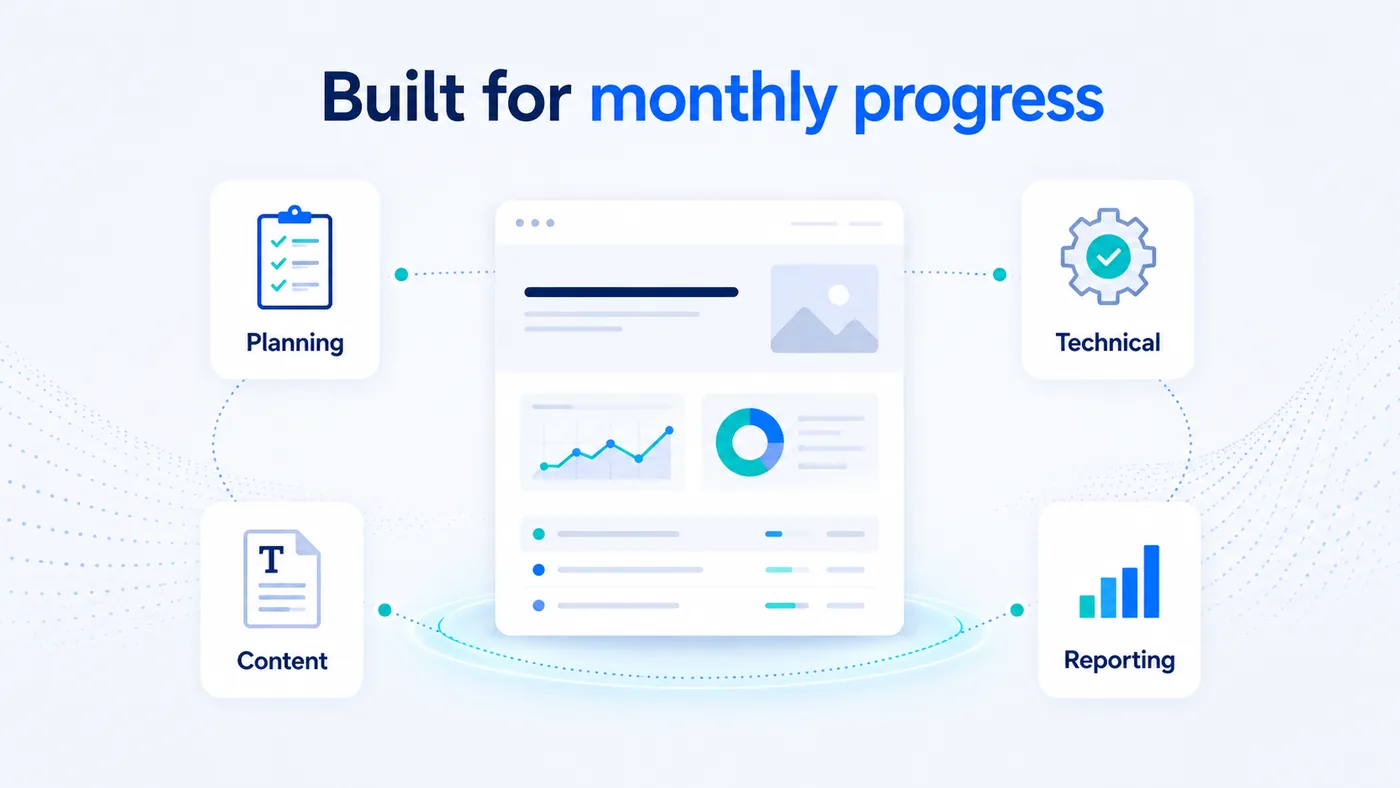
The technical layer comes first because everything else depends on it. Crawling, indexing, speed, mobile rendering, internal links, structured data. It is unglamorous, it rarely produces a chart anyone enjoys reading, and skipping it means the rest of the budget is spent on pages nobody can reach.
The content layer is where most of the monthly hours go, and it is not “blog posts”. It is deciding which questions the business should own, checking whether an existing page already half-answers one, and finishing it properly rather than publishing a new page that competes with it. We cover the underlying method on our page about semantic SEO and topical authority.
The authority layer is the slowest and the one most often oversold. In a package it means citations, listings, genuine references and the occasional earned placement, not a monthly link count. Where a business needs a real campaign, that is scoped separately as earned link building.
Measurement is the layer that makes the other three arguable. Rankings on named queries, impressions, enquiries, and a written note each month explaining what changed and why. Without it, every month reads the same and nobody can tell whether the money is working.
When is a fixed monthly package the right purchase, and when is it not?
Three questions decide it. Is the site reachable and indexed, is the work continuous rather than one-off, and is the scope predictable enough to fix in advance? Two of the three exits lead somewhere cheaper.
Three questions, and the two exits that cost you less
The first exit is the common one and the most expensive to get wrong. A site with an indexing problem does not need a monthly programme, it needs somebody to find out why pages are missing. Start a retainer instead and the first two months disappear into a diagnosis you could have bought once.
The second exit catches migrations and rebuilds. Those are projects with an end, and paying for them monthly is simply borrowing. We would rather quote the project and let the retainer start afterwards, when there is something continuous to do.
The third exit is about fit rather than cost. A business with several locations, an unusual sales cycle or a catalogue that changes weekly outgrows a tier list quickly, and the right answer is a plan built around the model rather than a band chosen from a table.
Why do we bill monthly rather than by project or by the hour?
Because the work never finishes and hourly billing rewards the wrong thing. A monthly fee against an agreed scope means we are paid for the outcome we said we would pursue, not for the time it took us to pursue it.
Hourly is the model with the clearest conflict of interest in it. Every efficiency we find costs us money, every hour we spend deliberating is billable, and the client ends up buying a timesheet rather than a result. It has a legitimate use for advisory calls, a second opinion or a specific investigation, and we use it for exactly those.
Project billing suits work with an end: an audit, a migration, a rebuild, a one-off cleanup. Where that is what you need we quote it as a project and say so, rather than converting it into twelve monthly instalments and calling it a retainer.
The monthly model earns its place when the work is continuous, which for search it usually is. Competitors publish, Google updates, your own catalogue changes, and last month’s finished page is this month’s out-of-date one. A fixed fee against a fixed scope makes that predictable for both sides, and the KPI agreement is what stops “predictable” turning into “unaccountable”.
What we do not do is bill against a share of media spend, or against hours logged, or against a link count. Each of those pays a supplier more for doing more rather than for achieving more, and the difference shows up around month six.
Is pay-as-you-go or no-contract SEO a real option?
No-contract is real and we offer it: thirty days’ notice, no minimum term. True pay-as-you-go, where you buy tasks individually with no plan behind them, is real too, and it almost never works.
The distinction matters because the two are marketed as the same thing. Several UK providers advertise pay-as-you-go SEO and a fair few advertise no-contract SEO, and a buyer reading quickly assumes they are buying flexibility either way. One of them is flexibility. The other is a shop.
No minimum term is the version worth having. It means the supplier has to earn the next month, every month, and it removes the single worst dynamic in this industry: a twelve-month lock signed on optimism in month one and endured from month four. Ours is thirty days’ notice in writing, and nothing is withheld on the way out.
Buying tasks individually is the version that fails, and the reason is sequencing rather than commitment. Search work compounds: the technical fixes make the content reachable, the content makes the authority useful, the authority makes the next page rank faster. Bought as separate items in whatever order the budget allows, each one arrives before the thing it depended on.
There is one honest use for task-by-task buying, and it is a business that already has an in-house marketer and needs a specialist for one specific thing. We do that, hourly, and it is a consultancy engagement rather than a package. What we will not do is sell a business its fourth disconnected task and let it believe it is running a programme.
Why does a small business need SEO every month rather than once?
Because the result you are competing for is re-decided constantly. Your page did not get worse; the page that overtook it got written last month, by somebody who is still writing.
This is the part that feels unfair and is worth understanding properly. Search results are not a leaderboard you climb and then hold. They are a comparison run fresh every time somebody searches, against whatever exists at that moment. A page that was the most complete answer in March is competing in November against three answers written since.
For a small business the effect is amplified by scale. A national brand can absorb six quiet months because it has hundreds of pages holding ground; a firm with fourteen pages has no depth to fall back on, and two competitors publishing steadily is enough to move it down a page.
There is also the maintenance half, which nobody enjoys paying for and everybody needs. Plugins update and break redirects. A redesign drops the internal links off a template. A staging site gets indexed. None of these announce themselves, and all of them cost more to fix six months late than to catch in the month they happen.
What monthly work is not is a treadmill you can never leave. The right target is a site that could pause for a quarter without a problem, and that state is reached by doing the work properly rather than by paying forever. Businesses that reach it usually reduce their tier rather than stopping, which is exactly what we would advise.
How do Google updates change what a package has to do?
Core updates re-assess whether your pages deserve their positions, and spam updates devalue whatever was manufactured. Neither is a penalty, and neither is something a package can prevent. What a package can do is make sure you are on the right side of both.
Core updates arrive several times a year and re-run the comparison across the whole index. Sites move without having done anything wrong, because the standard moved. The pages that lose ground are usually the ones that were adequate rather than complete: they answered the question, but less thoroughly than something published since.
Spam updates are the other kind and they behave differently. They target patterns rather than pages: bought links, generated content, doorway pages, scaled abuse of any sort. A site that never bought any of that is unaffected, which is the entire argument for not buying it, and it is why our packages carry citations and genuine references rather than a monthly link quota.
The practical answer inside a programme is to watch and respond rather than to predict. We record what happened around each update, look at which pages moved and in which direction, and treat a drop as information about coverage rather than as a mysterious punishment. Usually the page that lost is the page that was thinnest, and the fix is to finish it.
The one thing to be sceptical of is a supplier claiming to be update-proof or offering an “algorithm-proof” method. Nobody knows the next update. What is knowable is which practices have survived every update so far, and building only from those is the closest thing to protection there is.
What is missing from a very cheap monthly package?
Skilled time. At the bottom of the market the fee will not cover an hour of anyone senior, so everything in the list has to be automated, and automation is precisely what the spam updates are built to find.
The same five line items, and what the price actually allows
This is arithmetic rather than a moral position. A UK specialist’s time has a floor, and once a monthly fee falls below a couple of hours of it, the only way to deliver eleven line items is to generate them. That produces templated content, bulk links and an automated report, and the first two carry a risk the client is never told about.
The risk lands quietly. Nothing dramatic happens, rankings simply never move, and because they did not fall there is nothing to investigate. Twelve months later the business has paid a small amount every month, has nothing to show, and has usually concluded that SEO does not work.
Where a very small budget is genuinely all there is, the better purchase is a one-off audit and a written plan the business can execute itself. That is a real thing we sell, it costs less than a year of a cheap retainer, and it leaves the business with something.
What moves in month one, month three and month six?
Indexing first, then impressions, then positions, then enquiries. Enquiries are last, always, and any supplier promising them first is describing a different mechanism from the one that actually operates.
Four stages, and the specific thing to check at each one
Growth through consistency rather than through intensity
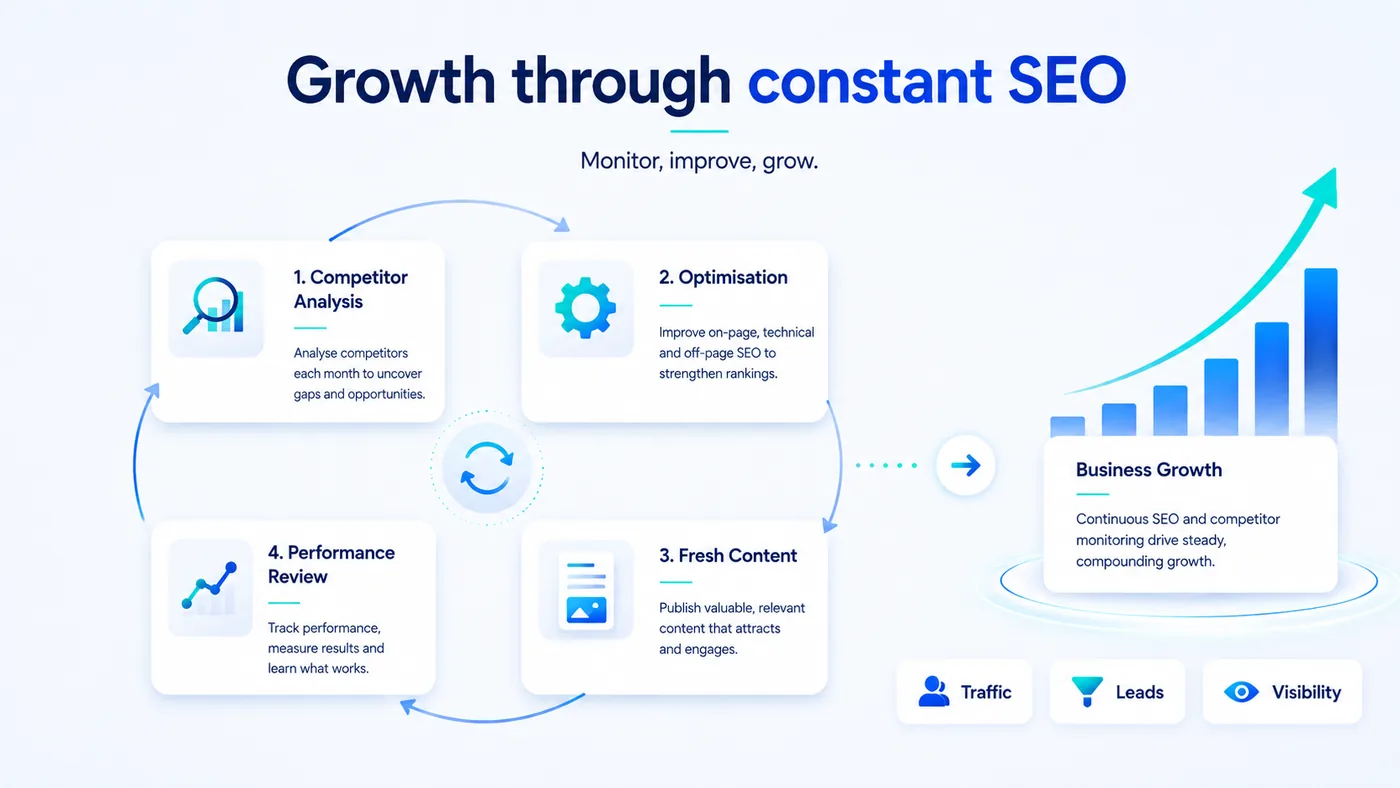
The shape of the curve is what makes short retainers disappointing. The cost is level from month one, the result is not, and a business that stops at month three has paid for the whole of the technical and structural work while collecting none of the return it was setting up.
That is also why we agree the ten queries at the start. Without them, month four is an argument about whether anything happened. With them, it is a list with numbers next to it, and the numbers are either moving or they are not.
Timescales vary with competition rather than with effort. A regional service business in a quiet niche can see positions move by month three; a national commercial term with established competitors is a twelve-month project and we will say so before you sign anything.
What happens to your rankings if you stop SEO for six months?
Nothing immediately, then a slow slide. The work already done keeps holding for a while, competitors keep publishing, and the gap opens quietly rather than collapsing.
One-time SEO against a programme that keeps running
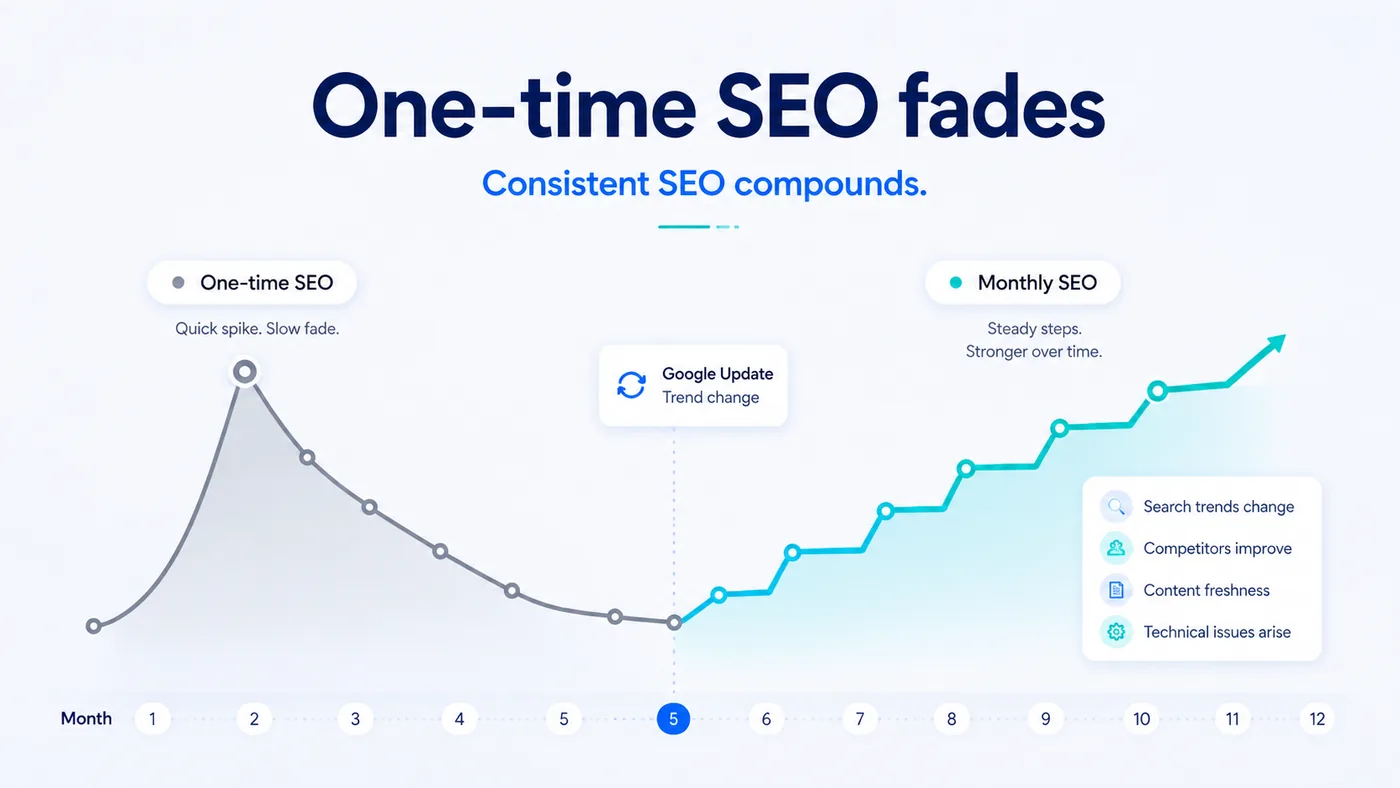
Three things cause the drift. Competitors publish while you do not, so pages that were the most complete answer stop being it. Google updates arrive and nobody adjusts. And technical debt accumulates quietly (a plugin update, a redesign, a broken redirect) with nobody watching Search Console to catch it.
The honest version is that a well-built site holds its positions for months rather than weeks, and a business that pauses for a quarter for cash-flow reasons is not throwing away what it paid for. A business that pauses for two years usually is, because by then the pages have been overtaken rather than merely matched.
If budget is the reason for stopping, say so and we will scale the scope down rather than end it. A reduced month that keeps the technical monitoring and one piece of content running holds far more ground than a full stop, and it costs a fraction of restarting from cold.
What are the contract terms: VAT, setup fees, notice, and who owns what?
Prices exclude VAT, there is no setup fee, invoices are monthly in advance on thirty-day terms, notice is thirty days in writing, and everything produced or earned belongs to you from the moment it exists.
| Term | How it works here | Why it is worth asking anyone |
|---|---|---|
| VAT | Tier prices exclude VAT, which is added at the prevailing UK rate | A quote that does not say either way is usually the one that surprises you |
| Setup fee | None. The first month is the first month | A separate onboarding fee is common and rarely mentioned until the first invoice |
| Payment terms | Monthly in advance, thirty days, by bank transfer or direct debit | Quarterly-in-advance is a way of creating a minimum term without naming one |
| Minimum term | None | Twelve-month locks exist because month four is when clients want to leave |
| Notice period | Thirty days in writing, effective at the end of the next billing month | Ninety-day notice on a monthly contract is a twelve-month term in disguise |
| Who owns the content | You do, on publication, including anything drafted but unpublished | Some agreements license content rather than transferring it, and it is removed on exit |
| Who owns the links | Nobody owns a link. Nothing earned is removed if you leave | Rented links disappear when the invoice stops, taking the ranking with them |
| Who owns the data | Analytics, Search Console and any tracking sit in your accounts, in your name | Properties created inside an agency account do not travel with you |
| Pausing | Scope can be reduced or paused by agreement rather than cancelled | All-or-nothing terms push businesses into stopping entirely for cash-flow reasons |
The bottom four rows are the ones worth taking to any supplier you are comparing us with, because they decide what happens on the worst day of the relationship rather than the best. A contract is easy to sign when everyone is optimistic; the terms only matter when somebody wants to leave.
Our arrangement is deliberately dull. You hold the accounts, we hold access, access can be revoked in a minute, and no part of a handover requires our cooperation. That is not generosity, it is the arrangement we would want if we were buying.
How is progress reported, and against what?
Against ten named queries and an enquiry target agreed before the first invoice, in a monthly report with a written explanation of what changed and why. Not a dashboard export with a logo on it.
| What you get | What it answers | When it starts being useful |
|---|---|---|
| Position on the ten agreed queries | Whether the specific things we said we would move are moving | Month three onwards |
| Qualified enquiries from organic | Whether any of it reached the business | Month six onwards |
| Impressions on the worked pages | Whether new coverage is being seen at all, before positions shift | Month two, the earliest honest signal |
| Indexed page count | Whether what we published is actually in the index | Month one |
| Work completed, itemised | What was actually done, checkable line by line | Every month |
| A written note | What changed, what it means, and what happens next month | Every month, and it is the part clients read |
| Anything that went wrong | Updates, drops, technical breakages and what we did about them | Whenever it happens, not at the next review |
The last row is the one that separates a report from a sales document. Rankings drop, updates land, plugins break redirects, and a report that only contains good news is not a report. We would rather send an awkward paragraph in month five than have you find out in month nine.
The written note exists because numbers on their own do not settle anything. Impressions rising while positions sit still means something specific, and it is either good or bad depending on what we did that month. Someone has to say which.
Which businesses does each tier suit?
The Starter tier suits a single-location business defending or building in a quiet market. The middle tier suits a business with named competitors to overtake. The top tier suits businesses publishing continuously or trading in a competitive national market.
The strategy decides the tier, not the other way round
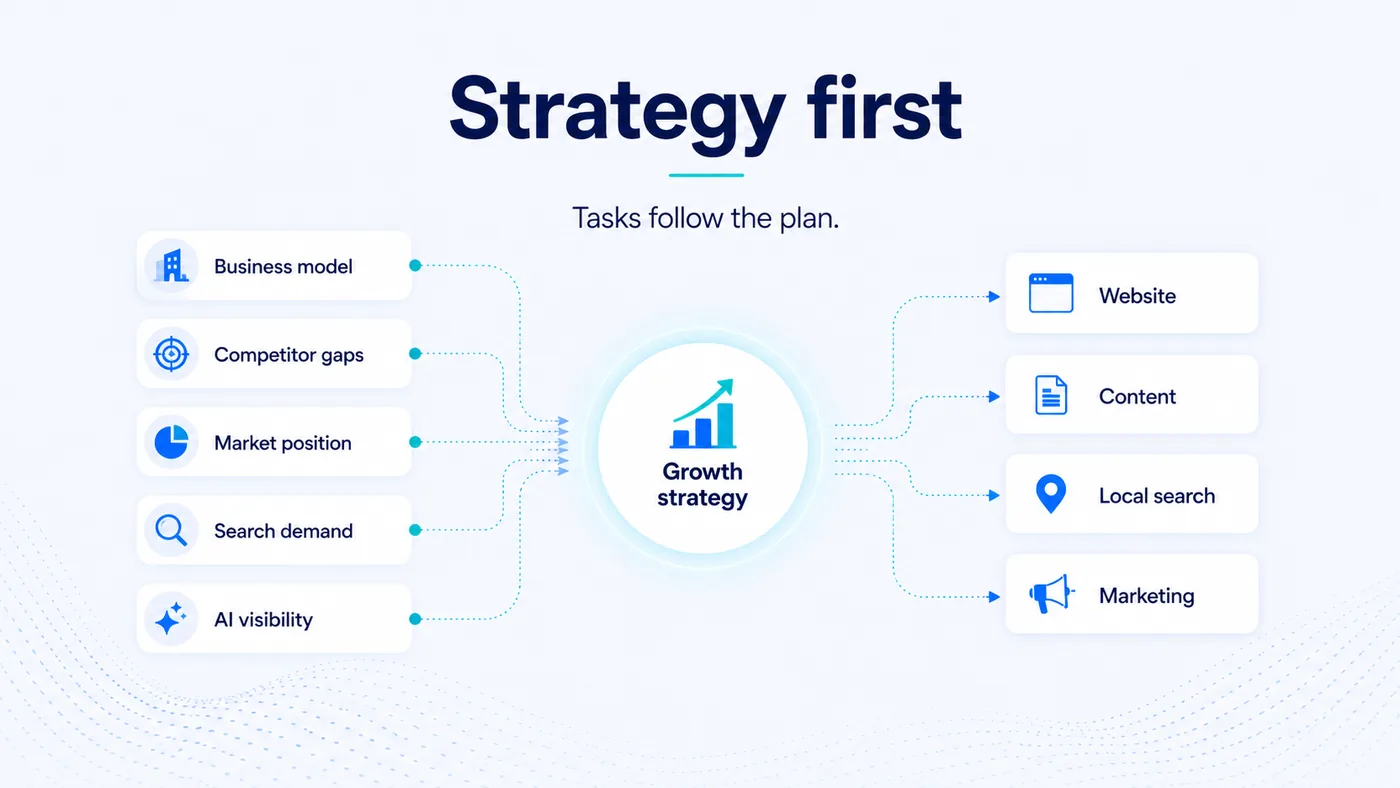
What actually decides the tier is competition rather than company size. A two-person firm in a contested national market needs more monthly work than a twenty-person firm serving one town, and pricing against headcount rather than against the search landscape gets that backwards.
Local businesses tend to sit comfortably in the lower bands, because proximity and the Business Profile do a great deal of the work and the competitive set is small. Where a business trades across several towns the calculation changes, and that is covered on our local and multi-location SEO page.
Where none of the three fits (an unusual model, a large catalogue, several brands under one roof) a tier list is the wrong instrument and we will say so. That work is quoted as bespoke SEO built around your business model instead.
Do you work with businesses in Cardiff and South Wales?
Yes. We are a Cardiff consultancy, and a good share of the packages we run are for businesses across South Wales, with the rest across the UK, delivered remotely.
For a package in particular, being local has one practical benefit: the monthly review can happen in a room rather than on a call, and half an hour listening to how enquiries actually arrive tells us more about which ten queries matter than any tool does.
Everything else is identical wherever you are. Our Cardiff SEO work covers the local search side, and the same tiers, terms and reporting apply nationally.
Frequently asked questions about SEO packages
Can we change tier later?
Yes, in either direction, from the next billing month. Moving up mid-programme is common once the technical work is done and the budget is better spent on content. Moving down is equally fine and we would rather do that than lose the continuity entirely.
Is there a minimum contract?
No. Thirty days’ notice in writing, effective at the end of the following billing month. We would ask you to give it six months before judging the result, but that is advice rather than a term, and the difference matters.
Do the prices include VAT?
No, the tier prices exclude VAT, which is added at the prevailing UK rate. There is no setup fee and no onboarding charge, so the monthly figure plus VAT is the whole invoice.
What do you need from us each month?
Less than most clients expect. Access to the site and the analytics at the start, a review of drafts before they publish, and someone who will answer a question about the business when we ask one. Programmes stall on the second of those more than anything else.
Who writes the content?
We do, and you correct the specifics only you know. Where a client wants to write it themselves we brief and edit instead, which usually improves it, because the person who does the work explains it better than anyone researching it from outside.
Will we rank number one?
Nobody can promise that and anyone who does is either guessing or targeting a phrase nobody searches. What we agree instead is ten specific queries and an enquiry target, both written down before the first invoice, so there is something real to be judged against.
What if we already have an agency?
Bring their reports to the free review and we will tell you honestly whether the work looks sound. Sometimes it does, and we say so. Where it does not, the useful part is usually understanding what is missing rather than switching supplier immediately.
Do you work with our web developer?
Yes, and it usually works better than us having direct access. We specify the change, they implement it, and nothing lands on your site that your own developer has not seen. Where there is no developer we do it ourselves.
What happens in the first month?
The technical baseline and the KPI agreement. We record indexed pages, positions on the ten queries, current enquiries and conversion rate before anything changes, so month six has something to be measured against. It is the least visible month and the one everything else depends on.
The next step
Find out which tier fits, or whether none of them do
Book a free thirty-minute review. We check whether your site is indexed, work out whether the work you need is continuous or one-off, and name the tier that matches it. If a one-off project is the cheaper purchase, we will tell you that instead.