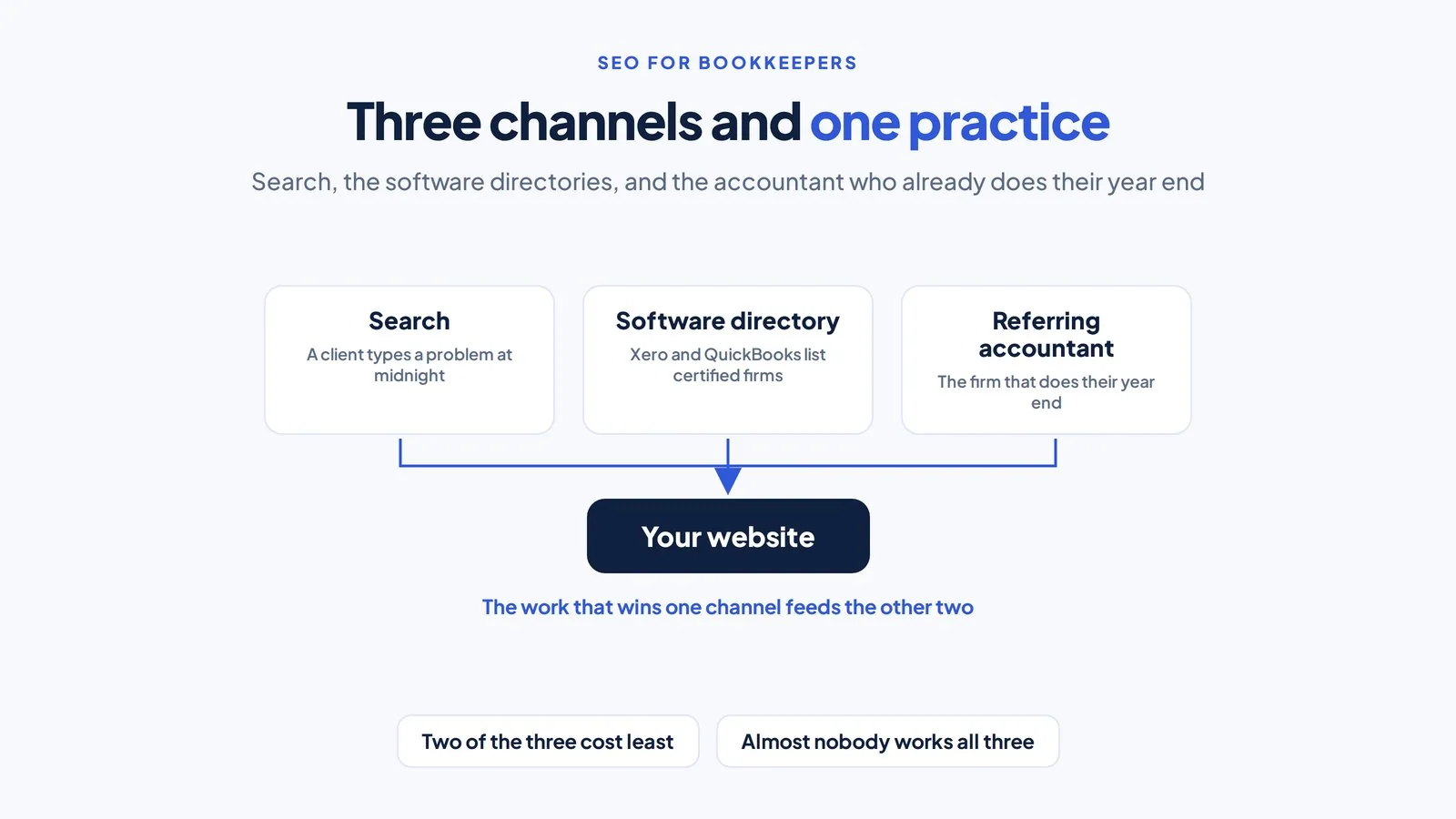
Your practice competes in three places at once, and only one of them is a search engine. Clients find a bookkeeper through a search, through a software partner directory, and through the accountant who already does their year end. Work on the first and ignore the other two and you are leaving the two cheapest channels you have.
This page covers all three, because the work that wins each one overlaps more than it looks.
Key Takeaways
- Bookkeeping is the product here, not the low value end of somebody else’s service list. The distinction matters and the next section sets it out.
- Your clients search for a situation, not a service. “Behind on my bookkeeping” brings you better work than “bookkeeper”.
- Xero states that every firm in its advisor directory has staff trained in Xero and eight or more clients on Xero.
- QuickBooks gives a free Find a ProAdvisor listing once a practice is certified, with four tiers set by points earned rather than by a ranking of firms.
- Publishing a monthly fee is an advantage a bookkeeping practice has and an accountancy practice usually does not.
- Your practice licence from ICB, IAB or AAT is a trust statement, and most bookkeeping sites bury it in a footer image.
- Automation takes the data entry and not the judgement, and publishing an honest answer to that question is the cheapest demonstration of expertise a bookkeeping practice has.
- The accountant who sends you work is a channel with a page of its own, and almost nobody builds it. Yours probably has not.
For bookkeeping practices
Getting the wrong enquiries, or not enough of them?
We start by working out which half of the bookkeeping market you want, then build the pages that bring it.
From our own audit of 494 sites
Three gaps a bookkeeping practice can close in an afternoon each, measured across the UK practice web estate.
- 87.2%practice sites publishing no price
- 98.0%with no page on switching provider
- 0.4%naming their money laundering supervisor
What does SEO for a bookkeeping practice involve?
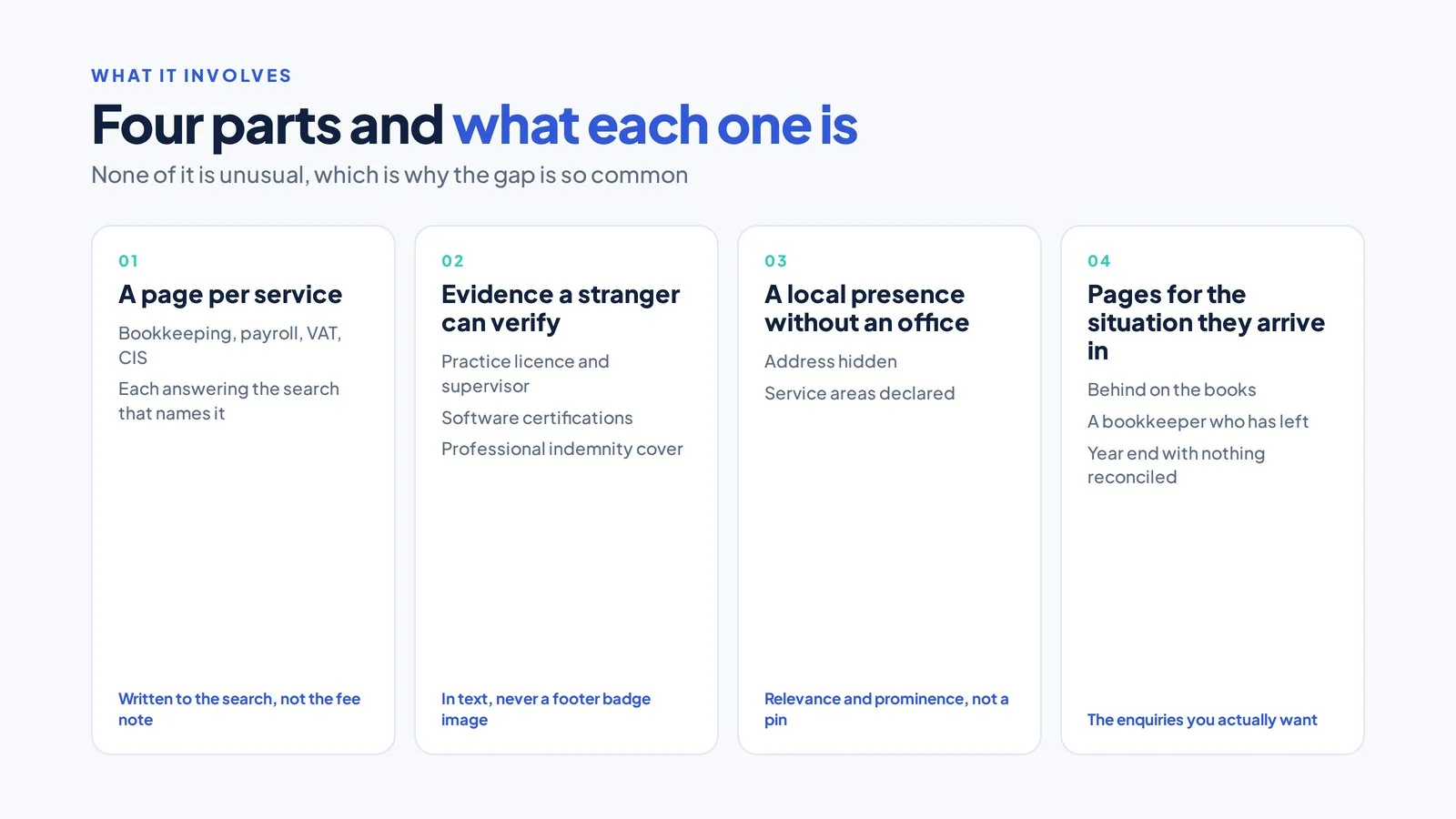
SEO for your practice involves four things. A page for every service you actually sell, written to the search a client runs rather than to the line on your fee note. Evidence a stranger can verify, which for a bookkeeper means the practice licence, the software certifications and the insurance. A local presence that works even where you never meet a client face to face. And a set of pages answering the situations that bring a client to you in the first place.
None of that is unusual. What is unusual is how rarely a bookkeeping site does any of it, because most were built to look tidy rather than to answer a search. Open yours and check the four.
The underlying approach is the same one we use for any practice, and it is set out in SEO for accountants. The rest of this page is what changes when you sell bookkeeping rather than buy it in.
Is bookkeeping low value work to be found for?
Bookkeeping is low value work for an accountancy practice trying to sell advisory, and it is the product for a bookkeeping practice. Both statements are true and they describe different businesses, which is worth stating plainly because the two get conflated constantly.
An accountancy firm that ranks for “bookkeeping near me” and nothing else has a problem. It has paid to build a virtual finance director capability and is receiving enquiries for forty pound a month data entry. That is a positioning failure, and we describe it that way elsewhere on this site.
You have the opposite situation. That search names your product. Your question is not whether to be found for bookkeeping, but which bookkeeping. A practice doing monthly management accounts, payroll for twenty staff and CIS returns for a construction client is not competing for the same enquiry as a practice doing a shoebox of receipts once a quarter, and a site treating both as “bookkeeping services” brings you the wrong half of the market.
Decide which half you want before you write a word, because every page below depends on your answer.
What do a bookkeeper’s clients actually search for?
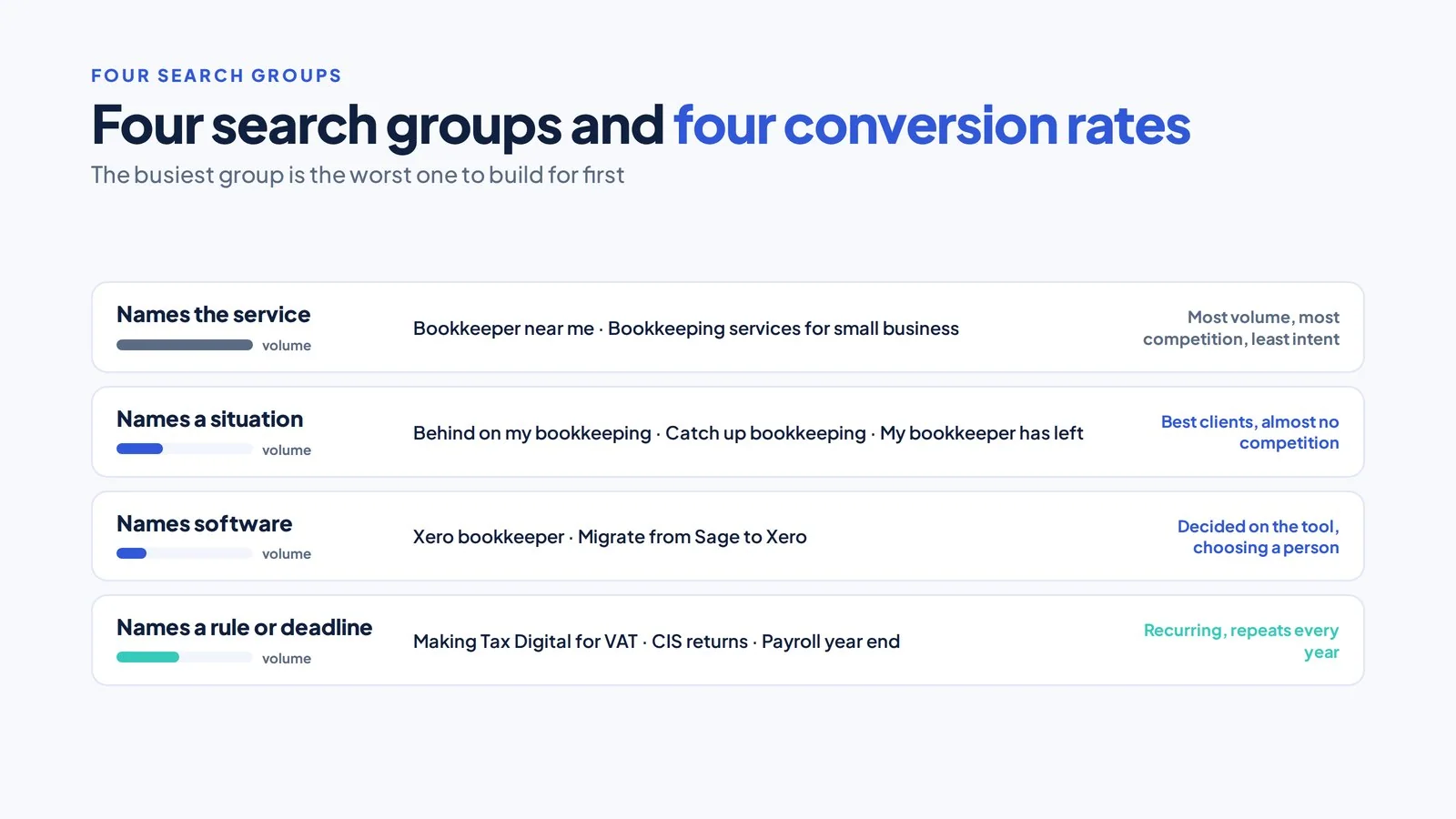
Your clients search in four groups, and the groups convert at completely different rates. The full category framework behind this, and how to find what competitors rank for, sits in keywords for accountants. What follows is the bookkeeping cut of it.
The first names the service. “Bookkeeper near me”, “bookkeeping services for small business”, “payroll bureau”. High volume, every bookkeeper in the county, and the searcher usually has nothing wrong yet.
The second names a situation. “Behind on my bookkeeping”, “catch up bookkeeping”, “bookkeeping in a mess before year end”, “my bookkeeper has left”. Lower volume and far better clients for you, because the person searching has a problem with a date attached to it and no time to shop around.
The third names a piece of software. “Xero bookkeeper”, “QuickBooks bookkeeper near me”, “migrate from Sage to Xero”, “Xero setup for a new business”. These convert well because the searcher has already decided on the tool and is only choosing a person. That person can be you for the cost of an afternoon’s writing.
The fourth names a rule or a deadline. “Making Tax Digital for VAT”, “CIS returns for subcontractors”, “payroll year end”. These bring your recurring work, and they repeat every year on the same dates.
Give each group a page to land on and the plan writes itself.
| Search group | Example | Page that should own it | What the page has to do |
|---|---|---|---|
| Names the service | bookkeeping services for small business | Service page, one per service | Say what is included and what it costs |
| Names the service and a place | bookkeeper near me | Home page plus the map profile | Win on relevance and prominence, not a pin |
| Names a situation | catch up bookkeeping | Situation page | Name the situation and the way out of it |
| Names a departure | my bookkeeper has left | Switching page | Explain what happens to the records |
| Names software | Xero bookkeeper | Software page, one per platform | Setup, migration, monthly working, certification |
| Names a migration | migrate from Sage to Xero | Software page, migration section | Timeline, what the client supplies, what breaks |
| Names a rule | Making Tax Digital for VAT | Rule page, refreshed yearly | What changes this year and what to do by when |
| Names a sector | bookkeeper for construction | Client type page | CIS, subcontractors, retentions, in their words |
The four groups above are the ones that behave differently for a bookkeeping practice. What follows is what to do with them.
Which pages does a bookkeeping practice need?
You need seven page types, and most bookkeeping sites carry two of them.
One page per service. Bookkeeping, payroll, VAT returns, management accounts, CIS, software setup and migration. Each as its own page, each answering the search that names it. One services page listing all seven cannot rank for any of them, however well it is written.
One page per software you work in, naming it in the title and covering setup, migration, monthly working and the certifications you hold.
One page per client type you actually serve. Construction, hospitality, ecommerce, tradespeople, landlords, charities. Written in that sector’s own words, with the issues you already know that sector has, rather than a generic page with a sector name at the top.
A page for the situation your clients arrive in. Catch up work, a departed bookkeeper, a year end approaching with nothing reconciled. These bring the enquiries you want and almost nobody builds them.
A pricing page. More on that below, because you can do something here that an accountancy practice usually cannot.
A page about your practice naming the licence, the supervisor, the insurance and the people who do the work. Not a mission statement.
A page for accountants. The firms referring work to you are a channel, they search too, and they need to know what you do and do not take on before they pick up the phone. Those seven are the bookkeeping set. A practice that also files accounts and returns needs a longer inventory, set out page by page in our accountancy practice website checklist. Two of those seven pages have a second home as well, because the software you work in has directories of its own.
Topical map
A page plan before any writing starts
Every search your clients run, matched to the page that should own it, with the order to build them in. Five hundred pounds ex VAT, delivered as a working document.
Which software directories send work, and how do you get listed?
Two software directories send real enquiries to bookkeeping practices in the UK, and both publish their entry requirements, which makes them unusually easy for you to plan for.
Xero runs an advisor directory and tells searchers to “Look for a bookkeeper or an accountant near you in the Xero advisor directory”. Xero states the entry condition directly: “All firms listed in the directory have staff members trained in Xero and eight or more clients on Xero.” Xero also presents its certifications and badges as a signal of an accountant’s or bookkeeper’s expertise in its products. Xero does not publish how the directory orders the firms it lists, so treat any claim you are given about that with the scepticism it deserves.
QuickBooks runs the ProAdvisor programme, and a practice is enrolled automatically on signing up for QuickBooks Online Accountant. Intuit states that “once you’re QuickBooks certified, you’ll get a free listing” in the Find a ProAdvisor directory. The programme has four tiers set by points earned: Silver from zero to 199, Gold from 200 to 799, Platinum from 800 to 2,999, and Elite from 3,000 upward. Points come from actions such as adding clients to QuickBooks products and completing certifications, with a QuickBooks Online client worth 10 points and Advanced Certification worth 100. Tiers are earned on points rather than assigned by a ranking of firms.
Treat both listings as part of your site rather than as something separate. Your practice name, address and phone number on each has to match the website exactly, the services listed have to match your service pages, and the description is worth writing properly rather than pasting in the first paragraph of your home page.
How should a practice licence appear on the site?
Your practice licence belongs in text, on the about page and in the footer, written as a sentence a search engine can read. Most bookkeeping sites carry theirs as a logo image in the footer, which is invisible to anything that cannot see pictures and unconvincing to a visitor who does not recognise the badge. Check where yours sits.
Name the body, name what your licence permits and name the supervision. A practice licensed by the Institute of Certified Bookkeepers, the International Association of Bookkeepers or AAT can say so in a sentence, and can say who supervises it for anti money laundering purposes. Our audit of 494 UK accountancy practice websites found only 39.1% stating who regulates the practice at all, and 0.4% naming an anti money laundering supervisor. Those figures are from accountancy practices rather than bookkeeping ones, and the pattern on bookkeeping sites is not better.
Add your insurance in the same place. Professional indemnity cover appeared on 7.5% of the practice sites we audited. A prospective client about to hand you their bank feeds is making a trust decision, and three sentences settle it. The next decision they make is about money, and you can settle that one too.
Should a bookkeeping practice publish its fees?
You should publish your fees, and it is one of the few things your sector can do that an accountancy practice usually cannot. Bookkeeping prices in a way that survives publication: a monthly figure tied to transaction volume, a payroll fee per payslip, a VAT return fee. None of that requires knowing a client’s affairs first, which is the usual reason an accountancy practice will not publish.
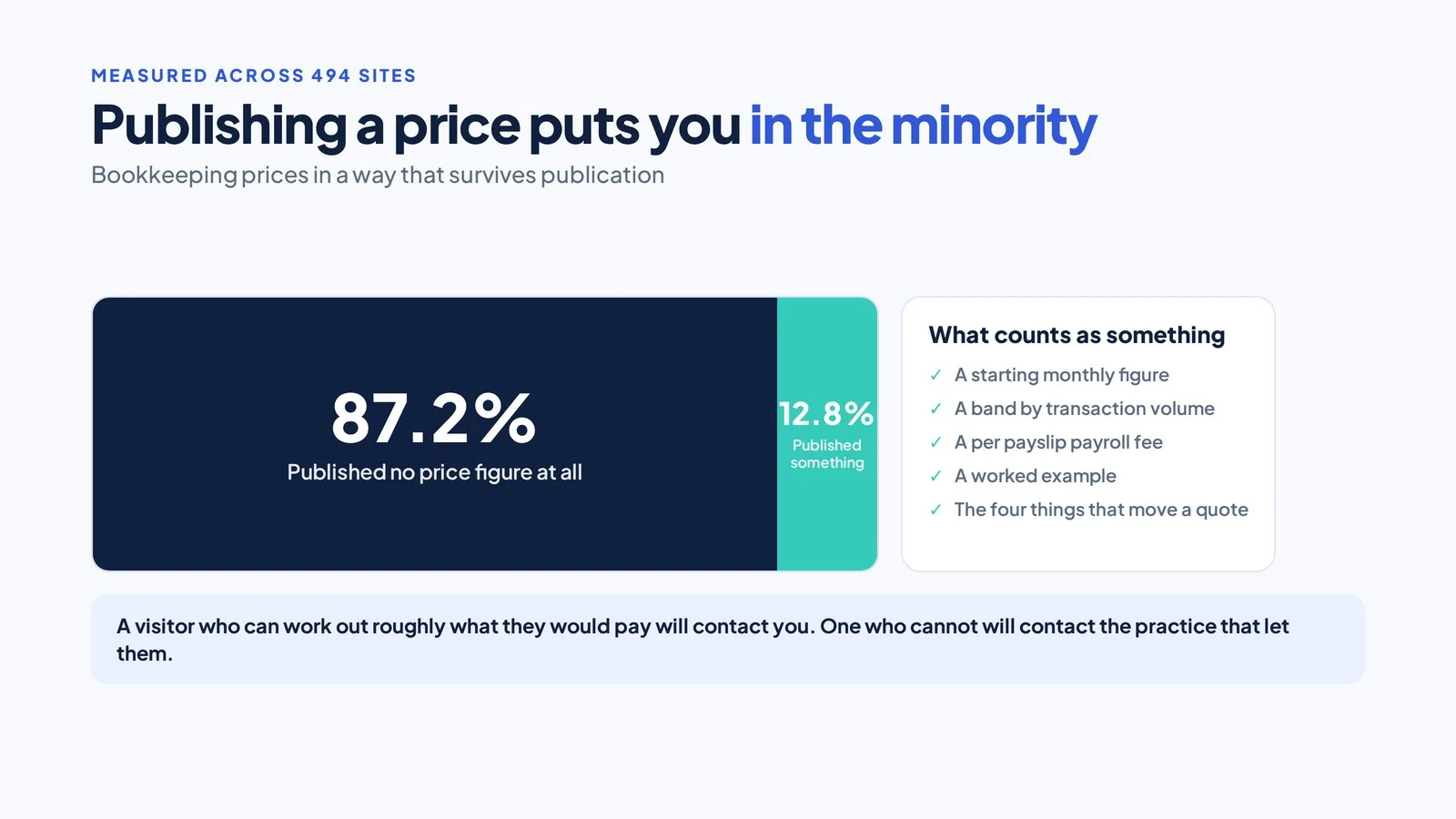
Across the 494 practice websites we audited, 87.2% published no price figure of any kind. Publishing one puts you in a small minority and does two jobs at once. It filters out the enquiries that were never going to buy, which saves your first meeting for people who will, and it gives a search engine something concrete on a page where your competitors have nothing.
Publish a real structure rather than a single number. A starting monthly figure, what it includes, what moves it up, and the point at which you quote individually. A visitor who can work out roughly what they would pay will contact you. A visitor who cannot will contact the practice that let them. Publishing is also the first of several things you can say that the accountancy firm down the road cannot.
How do you compete against an accountancy firm’s bookkeeping arm?
Compete on the thing their bookkeeping arm cannot match, which is that bookkeeping is your whole business rather than a feeder for something else.
Say it directly on the page. An accountancy firm’s bookkeeping team exists to produce clean figures for the year end and is staffed accordingly, usually by whoever has capacity that week. You work in the client’s ledger every week, catch the problem in month two rather than in month eleven, and answer the phone in March. Every one of those is a fact your clients recognise, and none of them appears on a typical bookkeeping site.
Then prove it with the things their page cannot carry. A published fee. Your software certifications, named. A turnaround time you will hold to. The person who actually does the work, named. A page explaining how a client moves across mid year, including what happens to the records and how professional clearance works, which almost no site has. Our audit found 98.0% of practice websites carrying no page explaining how a client changes provider at all.
The switching page matters more to you than to almost anyone, because your client is switching from someone rather than buying for the first time, and what they are worried about is the handover.
What does local search look like for a practice with no office?
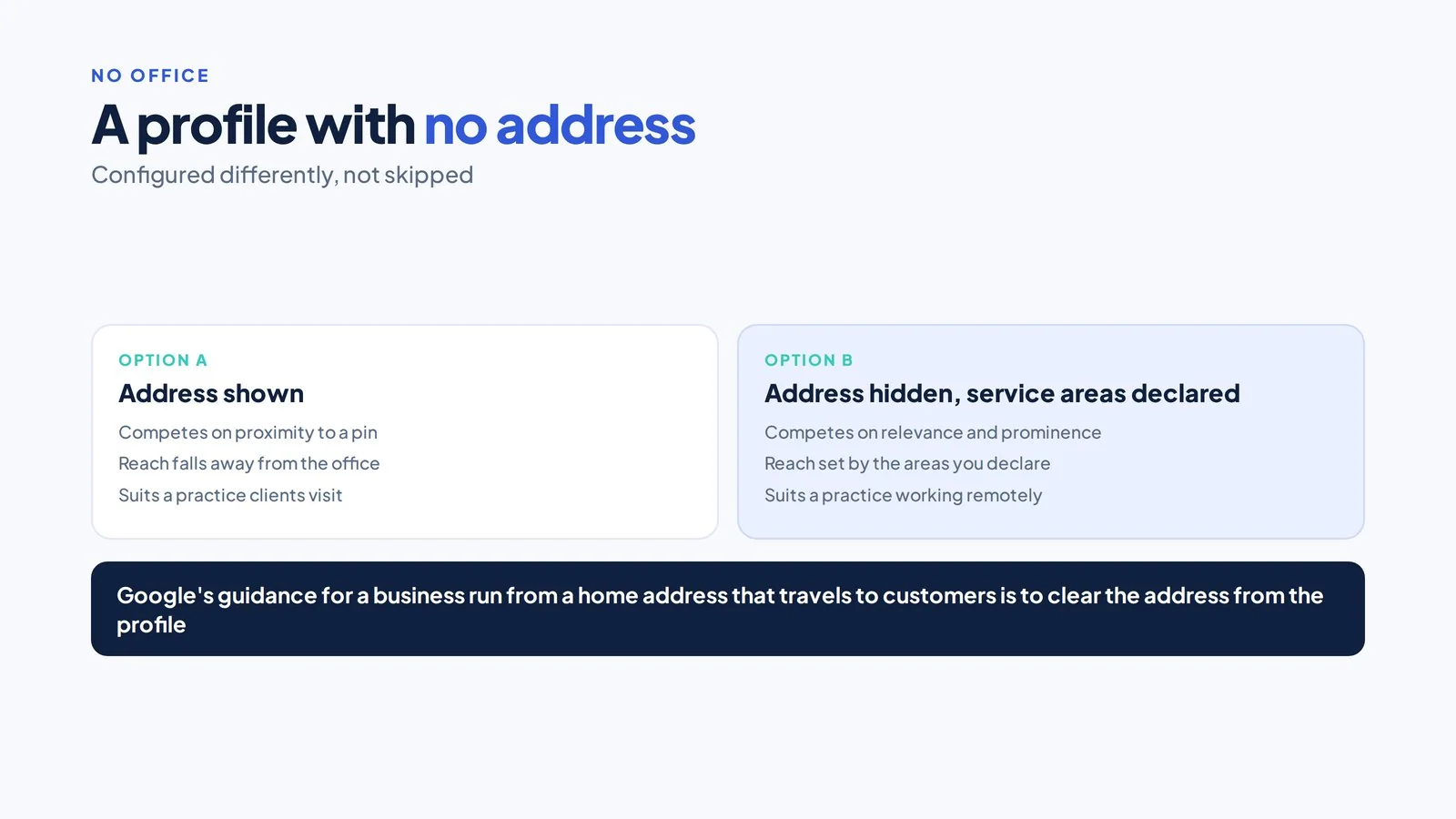
Local search still applies to you with no office, and the profile is set up differently rather than skipped. Google’s guidelines are direct about the residential case: for a business run from a home address that travels to customers, the guidance is to clear the address from the profile and set service areas instead.
That single decision changes what your profile can win. A profile with a hidden address and declared service areas competes on relevance and prominence rather than on proximity to a pin, which suits you if your clients are spread across a county or the whole country.
Everything else about winning that result, including which category to choose and how to handle reviews, is covered in local SEO for accountants, and it applies to your practice without modification.
Is AI replacing bookkeepers, and what should that change about what you publish?
Automation is taking the data entry and it is not taking the judgement, and the gap between those two is the thing worth publishing about. Bank feeds, receipt capture and rules based coding already do the work a client used to pay by the hour for, which is why a practice still selling itself on accurate data entry is competing with software that costs a client twenty pounds a month. The work that remains is reconciliation nobody else can resolve, VAT treatment that is not obvious, catching the error a rule created, and telling an owner what the numbers mean before their accountant does.
Prospective clients are asking the question too, in the same search box. Publishing a page that gives a straight answer does two jobs at once: it reaches people searching the question, and it demonstrates the judgement you are arguing cannot be automated. A practice that avoids the subject looks like a practice with an answer it would rather not give.
Three changes follow for the page set above.
- Write the service pages around outcomes a rule cannot produce. A page titled bookkeeping services competes with software. A page about untangling eighteen months of unreconciled transactions does not.
- Name the software you work in. A client who already uses Xero or QuickBooks is not choosing between you and the software, they are choosing someone to run it properly, and the search they type says so.
- Publish at least one piece on what automation does and does not handle in your work. It is the question your market is asking, your competitors are avoiding it, and answering it is the cheapest demonstration of expertise available to a bookkeeping practice.
Where should a bookkeeping practice stop?
Stop at the point where the page would describe work you do not do, and that line is usually crossed in two places.
The first is advisory. A page on business planning, forecasting or virtual finance director work attracts enquiries you cannot service and cannot refer without losing the client. Write it when you have the capability, not before.
The second is tax. Preparing VAT returns is bookkeeping. Publishing a page about corporation tax planning draws enquiries you will have to hand to the accountant you compete with. Where your licence covers the work, say so precisely. Where it does not, say what you do and name the boundary.
Naming a boundary reads as confidence. A site claiming everything reads as a site written by somebody who has not decided what the business is, which is also how a search engine reads it, because a source covering everything covers nothing deeply. Once the boundary is set, the only remaining question is whether any of it is working.
What should a bookkeeping practice measure?
Measure four things and ignore the rest for your first six months.
Impressions on the situation and software groups come first, because they move before positions do and they tell you the right pages are being shown for the right searches. Rising impressions on “catch up bookkeeping” means you are winning, even while your position for “bookkeeper” has not moved at all.
Enquiries with a source attached come second, and they only exist if somebody asks. Add one line to your enquiry form and one question to whatever whoever answers the phone says: how did you find us. Without it, your directory listings and your search work are indistinguishable, and one of them is usually doing far more than the other.
Enquiry quality comes third. Count your enquiries by the monthly fee they would carry rather than by how many arrived, because five enquiries at your top fee band and twenty at your lowest are not the same month, and a count tells you they are.
Client retention comes fourth and it is the one most practices never connect to this work. Clients who arrive through a situation page have told you their problem before they call, so you start the relationship already knowing what you are fixing. Those clients stay longer than the ones who arrived from a generic search, and after a year you can see the difference in your own fee ledger.
Those four are the measures that move for a bookkeeping practice. The wider set, including the numbers worth ignoring, sits in our piece on what an accountancy SEO programme includes.
Read all four monthly, and change one thing at a time. Change four things in a month and you will never know which one worked.
What to build first, in order
Build in this order, because each step makes your next one worth more.
Start with the service pages, one per service, because nothing else can rank until there is a page to rank. Then the software pages, because they convert best per visit and take a morning each. Then the fee structure, because it filters the enquiries the first two bring in.
Next, the practice licence, supervisor and insurance in text, which is a single afternoon and changes how every other page reads. Then the situation pages, which are the ones that bring the work you actually want. Then the client type pages for the sectors you already serve, written with the specifics only somebody who serves them would know.
Then the profile and the two software directories, by which point the site behind them supports the claims they make. Then the switching page and the page for referring accountants, which are the two pages nobody builds and both convert.
On our estimate that is about twelve weeks of steady work alongside your client work, and the order matters more than the pace you set.
Self-check quiz
Is your bookkeeping site built to be found?
Eight questions about the site you have now. Open it in another tab before you start.
Question 1 of 8Your services are presented as:
Question 2 of 8Pages naming a client situation such as catch up work:
Question 3 of 8The software you work in appears:
Question 4 of 8Your practice licence and supervisor appear:
Question 5 of 8Your fee position is:
Question 6 of 8A page explaining how a client moves to you mid year:
Question 7 of 8Your Xero or QuickBooks directory profile:
Question 8 of 8A page written for accountants who might refer work:
Show the answer key
- Your services are presented as: One page each. A page ranks for one search properly or for several badly.
- Pages naming a client situation such as catch up work: Several. Situation searches carry the clients with a deadline attached.
- The software you work in appears: As its own page per platform. A searcher who has chosen the tool is only choosing a person.
- Your practice licence and supervisor appear: In text on the about page and footer. A badge image is invisible to anything that cannot see pictures.
- Your fee position is: A structure a visitor can work from. 87.2% of the practice sites we audited published no figure at all.
- A page explaining how a client moves to you mid year: Yes, with what happens to the records. 98.0% of the sites we audited had no switching page.
- Your Xero or QuickBooks directory profile: Matches the site exactly and is written properly. Both directories send enquiries to a website, so the two have to agree.
- A page written for accountants who might refer work: Yes, naming what you do and do not take. Referring firms search too, and almost nobody builds for them.
Frequently asked questions
Is bookkeeping too competitive a search to win?
The service name is competitive and the searches around it are not. “Bookkeeper near me” has every practice in the county in it. “Catch up bookkeeping after a bookkeeper left” has almost nobody, converts far better, and takes one afternoon to write for.
Do I need a separate page for every service?
Yes, for anything you want enquiries from. A page can rank for one search properly or for several searches badly, and a services page listing bookkeeping, payroll, VAT and CIS together does the second. Split them and each one has a chance.
How much does SEO cost for a bookkeeping practice?
Our published prices start at 399 pounds a month for local work and 699 pounds a month for full service, both excluding VAT, on a rolling monthly basis with no notice period and no setup fee. What each band buys, and how to judge any quote, is set out in full in our piece on what SEO costs a practice.
Will listing on Xero and QuickBooks be enough on its own?
Not on its own. Both send real enquiries and both send them to a website, so a directory profile pointing at a site with no service pages and no fee position converts far below what it should. The two work together, which is why the directory step sits after the site work in the order above.
Should I publish my prices when competitors do not?
Competitors not publishing is the argument for publishing. A visitor comparing four bookkeeping sites where three say contact us and one gives a starting figure with the transaction volume it covers will contact the fourth, and the enquiries that arrive are pre-qualified.
My clients are all over the country, does local SEO still apply?
It applies and the profile is configured differently. Hide the address, declare the service areas, and the profile competes on relevance and prominence rather than on distance from a pin. That is the correct setup for a remote practice rather than a workaround.
Where bookkeeping fits in the rest of the work
Treat the practice as the source rather than as a service line, and the page plan follows from that. A bookkeeping practice covering its own subject completely, in its own clients’ words, with its licence and its fees in plain text, will outrank an accountancy firm’s single bookkeeping page every time, because that page is one of forty on a site about something else. Choosing which clients to cover completely is the part worth spending time on, and niche opportunities for accountants works through how that choice is made.
True SEO Consultants Ltd works from Startup Stiwdio at the University of South Wales, 86-88 Adam Street, Cardiff, CF24 2FN, and delivers UK wide through remote digital onboarding and delivery. Mohammad A Mahmud completed the ACCA professional examinations and holds an MSc in Applied Accounting from the University of South Wales, and Julie Williams is a fractional finance director and certified business coach, so a conversation about transaction volumes and fee structures happens in the practice’s own language. We bill on KPIs, not hours, with milestones in writing, and we publish our own research rather than borrowing statistics. Research Report TSC-2026-01, our audit of 494 accountancy practice websites, is where the figures on this page come from.
Tell us which clients you want and we will find the searches
Bring your service list and your software certifications, and we will show you the searches your practice could own inside a quarter.
Book my free strategy callSee the local work for practices