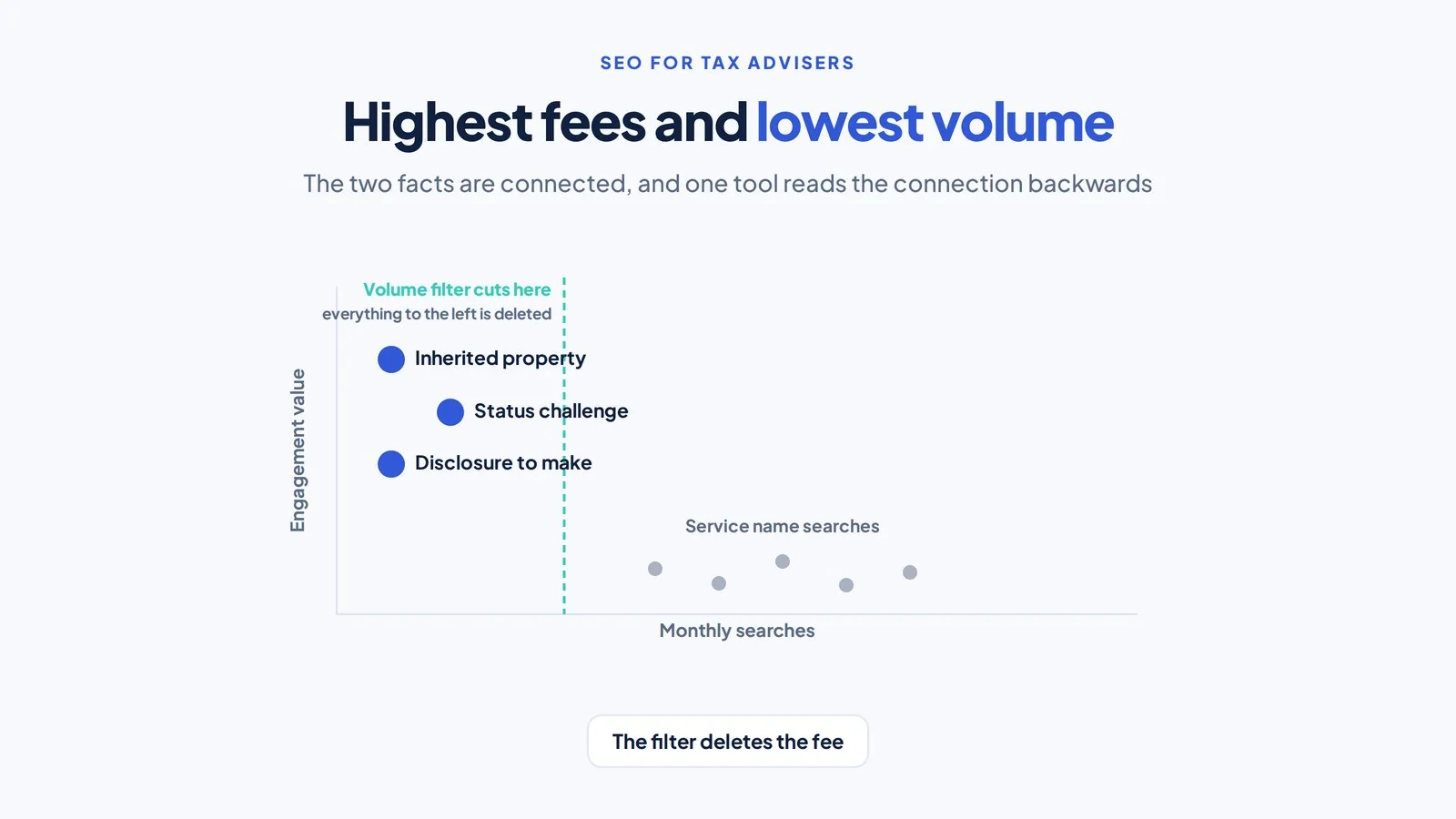
Your work carries the highest fees in the profession and the lowest search volume, and those two facts are connected. A search that brings you a five figure engagement is run by a handful of people a month, because only a handful of people a month are in that position. A keyword tool reads that as no demand and deletes it before you see it.
That single misreading is why tax firms end up with a website built around “tax advice” and “accountants near me”, and why the work you actually want arrives entirely by referral.
Key Takeaways
- Volume is the wrong measure for your work. Value per query is the right one, and no tool reports it.
- Your clients search the situation they are in, not the service you sell. Nobody types “capital gains tax planning” the week they exchange contracts.
- PCRT, produced jointly by seven bodies, sets five fundamental principles and five standards for tax planning, and those decide what a firm may put in a headline.
- Your credentials are entities a search engine can connect. CTA, ATT and STEP belong in text, not in a footer badge.
- The tax calendar compresses demand into a few weeks, which makes publishing a scheduling problem rather than a volume problem, and puts your writing in the quiet months.
- Search does not replace referral in your firm. It converts referral, because the person you were referred to checks you before they call.
- An assistant gives the general answer, which is what sends the serious client looking for a firm, so write the conditions rather than the rule.
- Writing about a technical area without giving advice is a solved problem, and the solution is structural rather than a disclaimer.
For tax specialist firms
Is your best work arriving only by referral?
We start from the engagements you have already done and turn each one into the search the client would have run.
Checkable facts, not claims
The standards your profession already publishes, and what practice websites currently say about themselves.
- 7bodies producing PCRT jointly
- 39.1%practice sites naming their regulator
- 0.4%naming a money laundering supervisor
What does SEO for a tax specialist firm involve?
SEO for your firm means building a page for every situation a client can be in when they need you, rather than a page for every service you sell. That is the whole difference, and everything else on this page follows from it.
A general practice sells services a client knows they need. Year end accounts, payroll, a VAT return. The client searches the service name because they already know what it is called.
You sell an answer to something your client cannot name. Someone who has inherited a property portfolio does not search “inheritance tax planning”. They search whether they have to sell the houses to pay the tax. Someone whose contractor status has been challenged does not search “IR35 advisory”. They search what happens now that HMRC says they are employed, usually the evening the letter lands. Think about the last three people who rang you and what they said first.
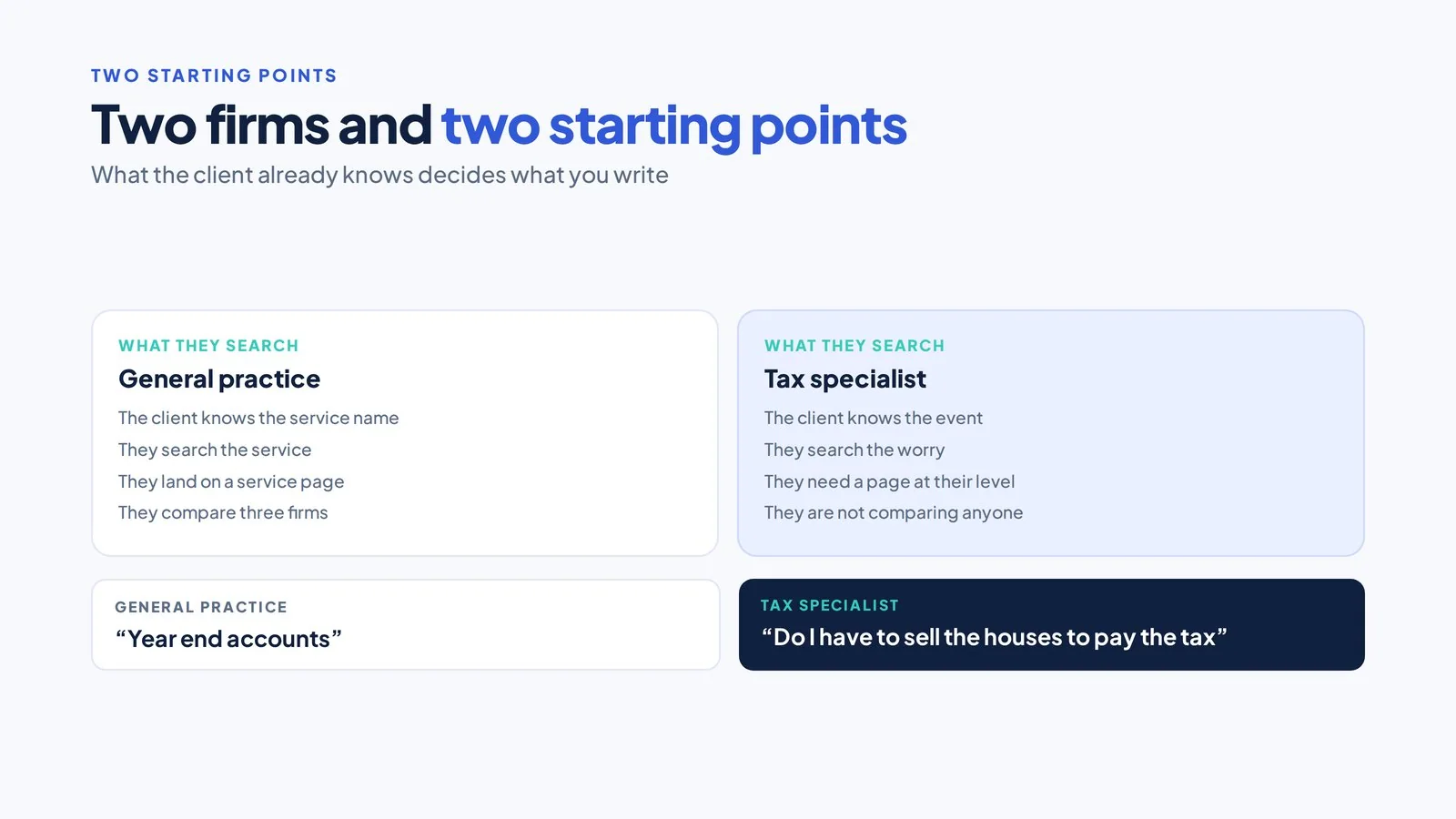
Build your pages at the level the client is at, and your service pages sit behind them as the place the reader goes once they understand what they need. The general approach behind this is set out in SEO for accountants, and the rest of this page is the part specific to tax work.
Why does volume led keyword research fail on tax work?
Volume led keyword research fails on your work because it sorts by the wrong number, and the sorting happens before anybody shows you the list.
A standard research process pulls a keyword list, filters out anything below a volume threshold, and hands over what remains. For you, that filter removes almost every query worth having. “Capital gains tax on a property I lived in for part of the time” might show ten searches a month. “Accountant near me” might show ten thousand. The filter keeps the second and deletes the first, and the first is the one attached to your fee note.
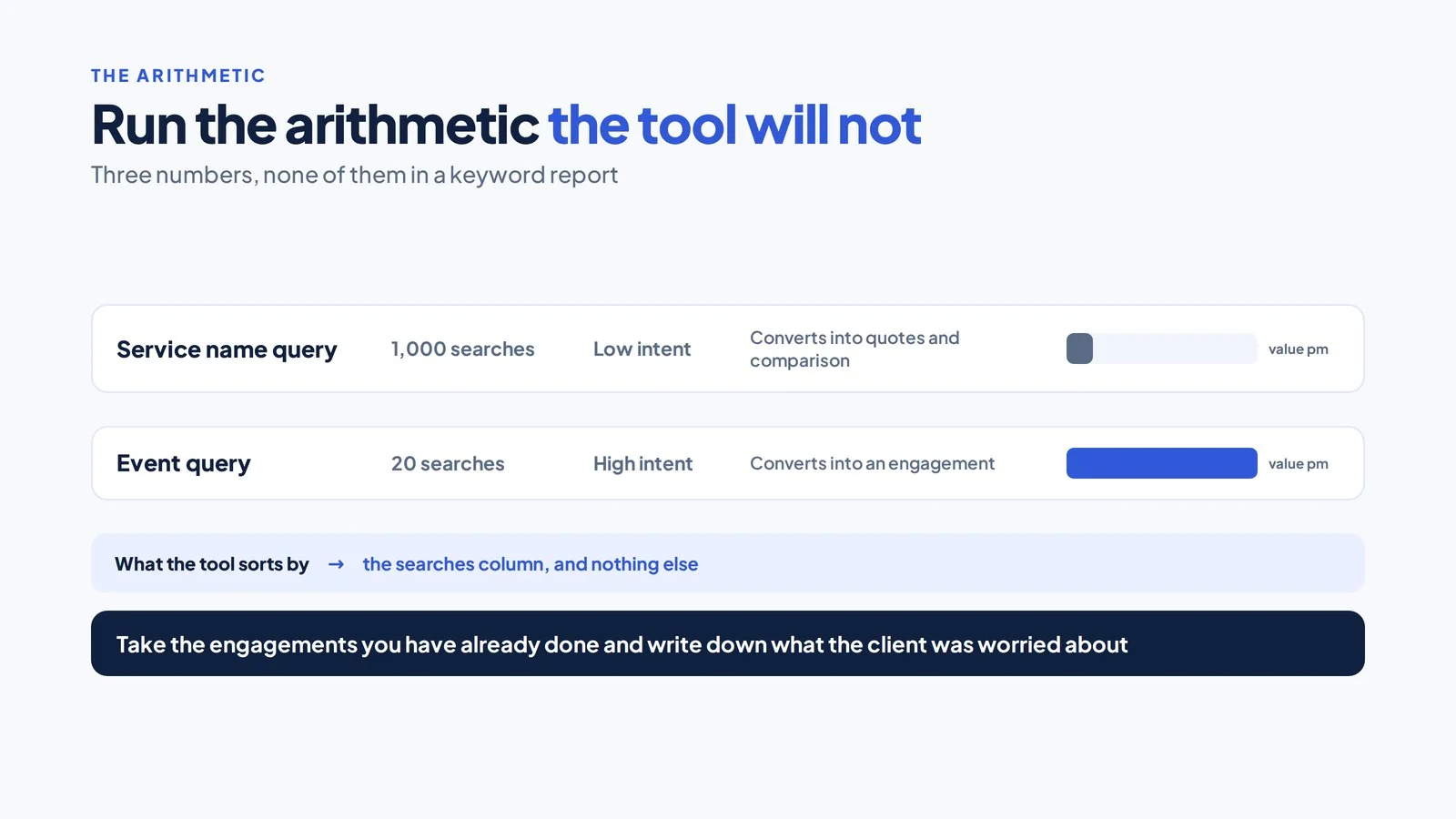
Work the other way. Take the engagements you have actually done over two years, pull them off the fee ledger, write down what each client was worried about when they first made contact, and turn each one into the sentence they would have typed. That list is your keyword research, and it will contain queries no tool reports at all.
Then check the arithmetic before you dismiss anything. A query showing a couple of dozen searches a month, converting at the rate a specific distress query converts, attached to an engagement worth five figures, outperforms a thousand searches for a service name that converts into quotes and comparison shopping. Nobody runs that arithmetic for you because the tool does not offer it. Running it yourself starts with knowing what your clients actually type, which is rarely what you would have guessed.
What do clients actually search when they need a tax specialist?
Your clients search in the language of the event that happened to them, and the events cluster into five groups.
Property and capital events. Selling a second property, a divorce settlement splitting assets, an inherited house, a share sale, a business disposal. The searches name the event and the worry, not the tax.
Status and employment disputes. A contract challenged, a determination received, a status check gone the wrong way, a payroll arrangement questioned.
Compliance gone wrong. An enquiry letter, a discovery assessment, an unprompted disclosure the client is trying to work out how to make, a penalty they want to appeal. These are the calls reception puts straight through to a partner.
Structure and relief. Research and development claims, enterprise investment relief, a group reorganisation, a holding company, an employee ownership trust.
Cross border and residence. Arriving in the UK, leaving it, a foreign income question, a residence position that changed mid year.
Set them out against what the client is actually worried about and the page plan becomes obvious.
| Group | What happened to the client | What they type | Page that should own it |
|---|---|---|---|
| Property and capital | Sold a second property | tax on selling a second home | Event page, property disposal |
| Property and capital | Inherited a house | do I have to sell to pay inheritance tax | Event page, inherited property |
| Status and employment | Contract status challenged | HMRC says I am employed what now | Event page, status challenge |
| Compliance gone wrong | Enquiry letter arrived | HMRC enquiry letter what happens next | Event page, enquiry response |
| Compliance gone wrong | Undeclared income to disclose | how to tell HMRC about income I missed | Event page, voluntary disclosure |
| Structure and relief | Spent money on development | does our project qualify for R and D relief | Event page, research and development |
| Structure and relief | Selling the business | selling my company what am I left with | Event page, business disposal |
| Cross border | Moved to or from the UK | moved abroad do I still pay UK tax | Event page, residence change |
Every one of those is a page. Not five pages for five groups, but a page for each specific event inside them, because the client searching about an inherited property and the client searching about a divorce settlement have nothing in common except a tax code, and neither of them recognises themselves in a page written for both.
How do you value a query nobody else wants?
Value a query on three numbers, none of which appear in the keyword tool you were handed.
First, the engagement value. What does the work bill, and what does it lead to afterwards. A research and development claim is rarely a single engagement, because a firm that files one usually files the next four, and you will already know that from your own ledger.
Second, the conversion rate of distress. A person typing a specific worry at eleven at night converts at a rate that bears no relation to a service name search, because they are not comparing firms. They are looking for somebody who has visibly seen this before, and you want that to be you.
Third, the competition. Count how many pages answer the question rather than mentioning it. Search three of your own event queries and count. The answer is routinely zero, because every competing page is a service page with the phrase in a sentence.
Topical map
Every event your clients arrive with, mapped to a page
A working document listing the situations, the search each one produces and the page that should own it, in the order worth building them.
Multiply the first two, divide by how hard the third makes it, and your ranking of queries inverts completely against what a tool would have given you.
What can a tax firm claim on its website?
You can claim what you can evidence and what your professional obligations allow, and PCRT is where those obligations are written down. Professional Conduct in Relation to Taxation is produced jointly by seven bodies: AAT, ACCA, ATT, CIOT, ICAEW, ICAS and STEP. The edition in force from 1 October 2025 sets out five fundamental principles and five standards for tax planning.
The fundamental principles are integrity, objectivity, professional competence and due care, confidentiality, and professional behaviour. Integrity is defined as “To be straightforward and honest in all professional and business relationships”. Professional behaviour requires a member to comply with relevant laws and regulations, to behave consistently with the profession’s responsibility to act in the public interest, and to “avoid any conduct that the member knows or should know might discredit the profession”.
The five standards for tax planning are client specific, lawful, disclosure and transparency, advising on tax planning arrangements, and professional judgement and appropriate documentation.
Read those against your own home page and three common headlines fall over.
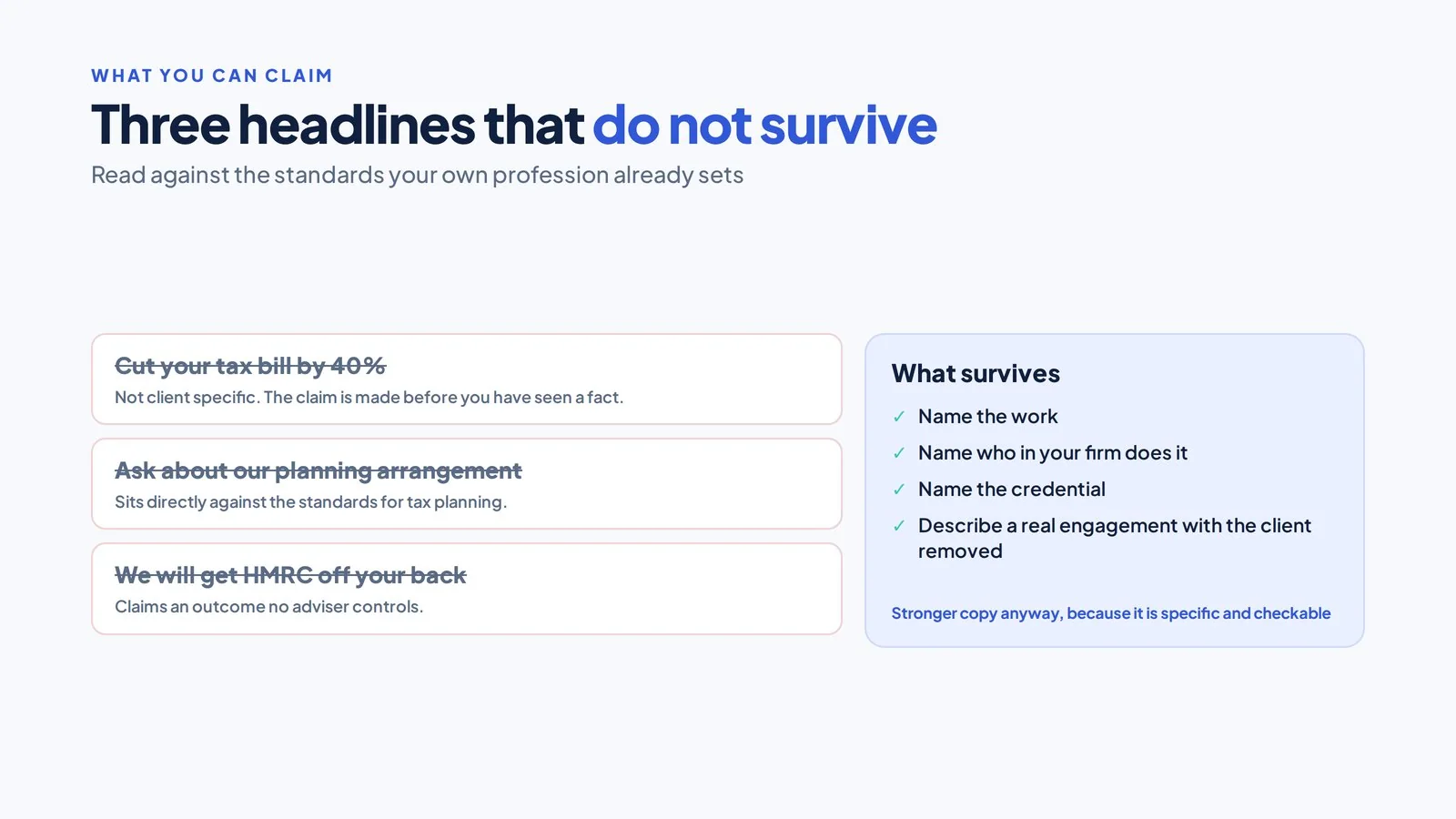
A headline promising to cut a reader’s tax bill by a stated percentage is not client specific, because it makes the claim before you have looked at a single fact. A headline offering a scheme or an arrangement sits directly against the tax planning standards. A headline implying an outcome with HMRC claims something you do not control.
What survives is stronger copy anyway. Name the work, name who in your firm does it, name the credential, and describe a real engagement with the client’s identity removed and your own conduct at the centre. The conduct rules the professional bodies apply to advertising more generally are covered in the ICAEW and ACCA marketing rules for accountants.
Which pages does a tax specialist firm need?
You need five page types, and the balance between them is different from any other practice.
Event pages come first and carry the most weight. One page per specific situation, written at the level of the person living through it, ending at the point where they understand what kind of help they need and that you provide it.
Technical pages sit behind them, one per area of work, written for the reader who has arrived from an event page or from a referrer checking what you do. These carry the terminology, your scope and your boundaries.
Credential pages carry your people. You sell named individuals more directly than any other kind of practice, and a biography naming the qualification, the years, the specialism and the work published under that person’s name does more for you than a services page ever will.
A referrer page addresses the accountants and solicitors who send you work. Say what you take, what you do not take, what happens to their relationship with the client afterwards, and how quickly you respond. Almost nobody has this page and your firm depends on the audience it serves.
A process page explains what happens after they contact you. A client holding an enquiry letter wants to know what your first week looks like, what your engagement letter will cover and roughly what the first meeting costs, before they ring anybody.
The referrer page is worth a paragraph of its own, because it is the one most often missing and the one with the clearest return. It has six jobs: name the work you take, name the work you decline, state what happens to the referring firm’s relationship with the client afterwards, state your response time, give a named contact rather than a general enquiry form, and set out how fees work between the two firms. An accountant who reads all six on one page refers to you with confidence. An accountant who finds none of them refers to whoever they used last time. Those five are the tax specialist set. A general practice needs a different and longer inventory, set out page by page in our accountancy practice website checklist. Every one of those five page types is read by somebody checking whether you are the right person, which is why the names and qualifications on them matter more here than anywhere else.
How should credentials appear on the site?
Your credentials belong in text, in the biography, on a page a search engine indexes, and not in a strip of badge images in your footer.
Name the body in full and the individual in your firm who holds it. Chartered Tax Adviser, the Association of Taxation Technicians, the Society of Trust and Estate Practitioners. The Chartered Institute of Taxation describes itself as “the leading body in the UK for taxation professionals dealing with all aspects of taxation”, and its primary purpose as promoting education in taxation. Your people hold that qualification, which gives you something specific to say, and a logo in the footer says none of it.
Do the same with your supervision. Our audit of 494 UK accountancy practice websites found 39.1% stating who regulates the practice and 0.4% naming an anti money laundering supervisor. Both are a sentence, both are checkable by a stranger, and both decide whether somebody with a serious problem picks up the phone to you. When they pick it up is decided by something you do not control at all, which is the calendar.
What does the tax calendar do to a publishing plan?
The tax calendar compresses demand into a handful of short windows, and your publishing has to run ahead of each one rather than into it.
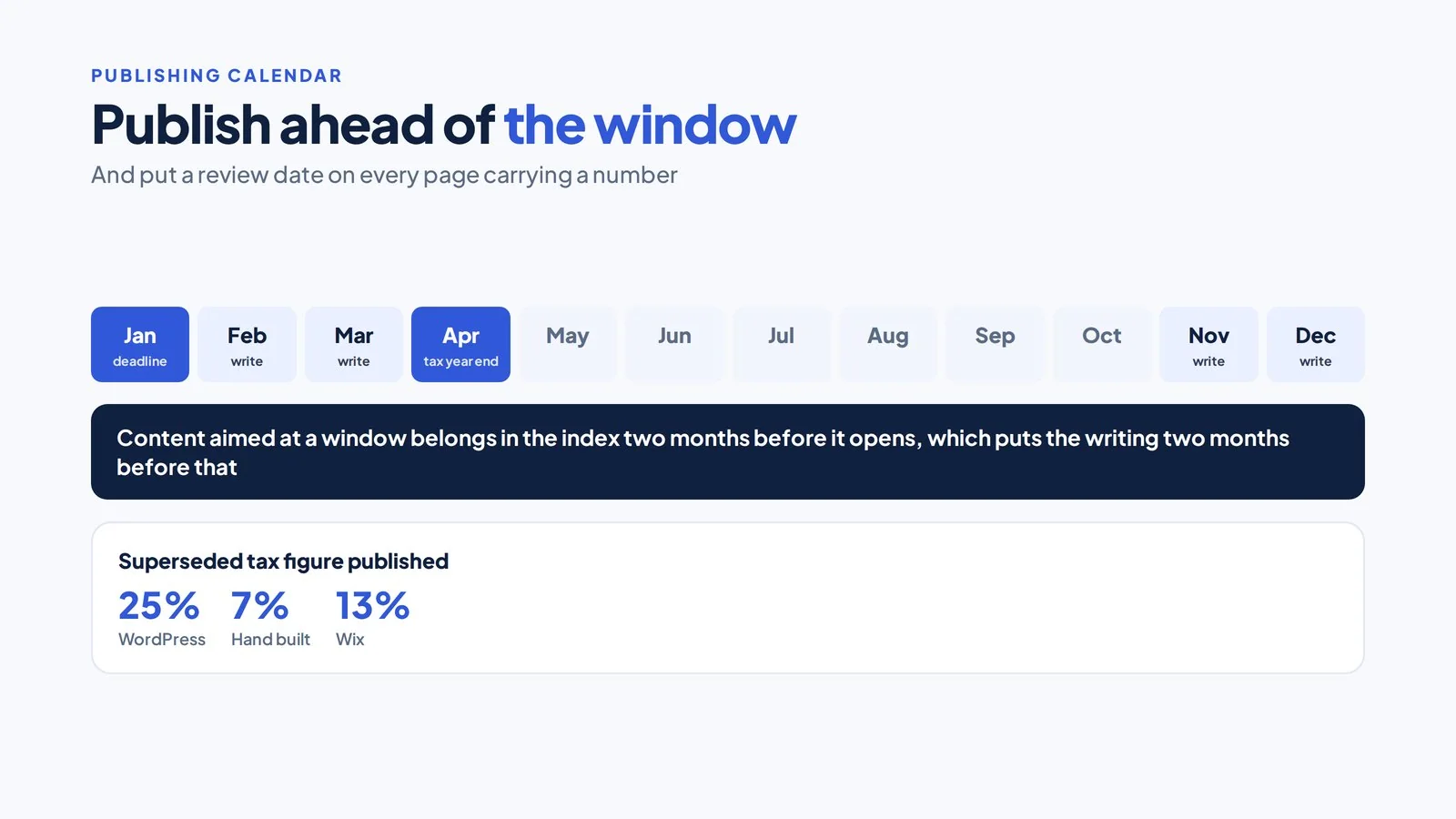
Work back from the dates that generate searches, which are the dates already in your diary. The self assessment deadline in January, the end of the tax year in April, the corporation tax filing pattern that follows each client’s year end, and the payment dates in between. Content aimed at a window belongs in the index at least two months before it opens, which puts your writing two months before that.
Refresh rather than rewrite. An event page about a property disposal does not change every year, but the rates and thresholds inside it do, and a page carrying last year’s figure damages you more than no page at all. Across the sites we audited, 25% of WordPress practice sites were publishing a superseded tax figure, against 7% of hand built sites and 13% of those on Wix.
Put a review date on every page carrying a number, and put that review in the same diary as your filing deadlines rather than treating it as maintenance. All of that assumes search is bringing you strangers, and in most tax firms it is doing something else entirely, closer to what happens after a referral than before one.
How does search work in a firm that lives on referrals?
Search converts your referrals rather than generating them, which is a different job and is worth more than most partners expect.
Follow what actually happens. An accountant tells a client to speak to you about a disposal. The client does not ring. They search your firm’s name, open your website, read your page about disposals, read the biography of the person they were told to ask for, and then ring reception. The referral generated the intent. Your website decided whether it survived contact.
That changes what your site is for. A firm receiving most of its work by referral needs its name searches to land somewhere that confirms the referrer’s judgement: the specific work, the named people, the credentials, a real engagement described properly, and a clear route to a first meeting.
It also changes what you measure. Branded searches rising is the signal that your referral volume is rising, and watching only non branded positions means missing your own best channel improving.
How do you write about tax without giving advice?
Write about the situation and your process rather than the treatment, and the problem solves itself structurally.
A page can say what the event is, what typically becomes relevant when it happens, what information a client should gather before they speak to you, what the deadlines are, what usually goes wrong when people wait, and what your first meeting covers. None of that is advice, all of it is useful, and it answers the question the searcher actually asked, which is what happens to me now.
A page should not say what the reader should do about their own circumstances, what their liability will be, or what treatment applies to their facts. Those depend on facts you have not seen yet.
The line sits in the same place PCRT puts it. Client specific means the advice belongs to the client’s circumstances, and a web page has no access to those. Write to that line and your pages are more useful than the competitors who hedge everything, because hedging removes the information and keeps the risk.
What happens when a client asks an assistant the tax question instead of you?
They get a general answer, which is exactly the outcome that sends the serious ones looking for a firm. An assistant asked about a tax point gives the version that holds in most cases, and tax work that is worth paying for is work where the general version does not hold. A client whose situation has a condition attached, a second property, a foreign element, an enquiry already open, reads a general answer and understands that they need somebody to look at theirs.
That hands a tax firm a specific job on its pages. Write the conditions rather than the rule. A page that states the relief and stops is competing with an answer the client has already been given for free. A page that states the relief and then sets out the three situations where it does not apply, in plain terms and without advising anyone, is the page that gets quoted and the page that gets the call.
Two practical consequences for the page set above.
- The situational pages matter more than the service pages here, which is the opposite of the position in general practice. Nobody searches for a tax adviser in the abstract. They search from inside a situation.
- Naming the condition, the threshold or the deadline in the text is what lets a machine quote you accurately. A passage lifted out of your page arrives without the heading above it, so the qualifier has to be inside the sentence.
The limits are the same ones that apply everywhere else on this page. Nothing published is advice, the conditions are stated rather than applied, and no provider can promise that an assistant will name your firm. What a firm controls is whether the specific answer exists anywhere on its site, and for most tax firms today it does not.
What should a tax specialist firm measure?
Measure four things, and give the first one longer than feels comfortable to you.
Impressions on event queries come first. These move slowly because the volume is small, and a page can take two quarters to establish on a query that runs a few dozen times a month. Reading them weekly will tell you nothing.
Branded search volume comes second, because it is the referral channel showing itself in a number.
Enquiries by type come third. Sort them by the work they concern rather than counting them, because you can have a flat month by volume and a record month by value, and only one of those shows up at the partners’ meeting.
Conversion from enquiry to engagement comes fourth, and it tells you whether your pages are attracting the right people. A high enquiry count with a low conversion usually means the site is pitched at a more general reader than you actually serve.
Those are the measures that move for tax work. The general set, and the numbers worth ignoring, sit in our piece on what an accountancy SEO programme includes.
What to build first, in order
Start with five event pages covering the work you most want more of. Not the work you do most of, the work you want more of, because that is the only reason to do any of this.
Then your biographies, in full, with the credentials in text and a named specialism each. Then the technical pages sitting behind the event pages. Then the referrer page, which gives you more back per hour spent than anything else on this list. Then the process page.
Only then your service pages in the conventional sense, because by that point they have something linking into them and a reason to exist beyond completeness.
At one page a fortnight the whole list is behind you in six months, and your first two event pages will be producing enquiries long before you finish it.
Self-check quiz
Is your site built for the work you want?
Eight questions about the firm’s site as it stands. Open it in another tab before you start.
Question 1 of 8Pages written to a client situation rather than a service:
Question 2 of 8Your people’s credentials appear:
Question 3 of 8A page addressed to referring accountants and solicitors:
Question 4 of 8Pages carrying a rate or threshold have a review date:
Question 5 of 8Your headlines claim:
Question 6 of 8A page explaining what happens in the first week after contact:
Question 7 of 8Real engagements described on the site:
Question 8 of 8You know which searches brought last quarter’s enquiries:
Show the answer key
- Pages written to a client situation rather than a service: Five or more. The client cannot search for the service, because they do not know what it is called yet.
- Your people’s credentials appear: In text in each biography. A badge image says nothing to anything that cannot see pictures.
- A page addressed to referring accountants and solicitors: Yes, with scope, response time and a named contact. The highest return page on the list per hour spent.
- Pages carrying a rate or threshold have a review date: Every one. A quarter of the WordPress practice sites we audited were publishing a superseded tax figure.
- Your headlines claim: What the firm does and who does it. A claim made before the facts are seen is not client specific.
- A page explaining what happens in the first week after contact: Yes. Somebody holding an enquiry letter wants to know this before they ring.
- Real engagements described on the site: Several, with the client removed and conduct at the centre. The page a competitor cannot copy.
- You know which searches brought last quarter’s enquiries: By type and by value. A flat month by volume can be a record month by value.
Frequently asked questions
Is there enough search volume to justify SEO for a tax firm?
Volume is the wrong test. A query attracting twenty searches a month from people facing a specific event, converting into engagements worth five figures, is worth more than a thousand searches for a service name. Run the arithmetic on engagement value rather than on the tool’s volume column and the picture inverts.
Can a tax firm publish case studies?
Yes, written to the professional obligations. Describe the firm’s own conduct rather than the client’s identity or affairs, keep the claim to what happened rather than what a reader could expect, and get the client’s agreement before publishing anything that could identify them. The five standards for tax planning in PCRT are the right reference for what a page may claim.
Should a tax firm write about tax rates and thresholds?
Yes, with a review date attached to every page carrying one. A page with last year’s figure is worse than no page, because it tells a reader the firm does not maintain its own material. Across the practice websites we audited, a quarter of the WordPress sites were publishing a superseded tax figure.
We get all our work from referrals, so why would we do this?
Because the referral does not end in a phone call. It ends in a search for your firm’s name, and what that search finds decides whether the referral survives. A site that confirms the referrer’s judgement converts more of them, and rising branded search volume is how you see the channel working.
How long does it take before event pages produce anything?
On our experience two quarters is a realistic first read on a low volume query, and six to nine months before the pattern is clear. The low volume that makes these queries valuable also makes them slow to measure, and a provider offering a faster answer is offering something the numbers cannot support.
Do we need a page for every area of tax we cover?
No. Build for the work you want more of and leave the rest as part of a technical page. A firm covering everything at the same depth reads as a general practice, which is the position a tax specialist is trying to move away from.
Where tax work fits in the rest of the practice
Treat the specialism as the thing being made findable rather than the firm, and the plan gets simpler. A tax specialist firm wins by covering a narrow set of situations more completely than anybody else, in the words of the people living through them, with named individuals and checkable credentials attached. That is the same argument for niche coverage set out in niche opportunities for accountants, applied to the highest value work in the profession.
True SEO Consultants Ltd works from Startup Stiwdio at the University of South Wales, 86-88 Adam Street, Cardiff, CF24 2FN, and delivers UK wide through remote digital onboarding and delivery. Mohammad A Mahmud completed the ACCA professional examinations and holds an MSc in Applied Accounting from the University of South Wales, and Julie Williams is a fractional finance director and certified business coach, which is why a conversation about engagement values and referral economics happens in the firm’s own terms. We bill on KPIs, not hours, with milestones in writing, and we publish our own research rather than borrowing statistics. The figures on this page come from Research Report TSC-2026-01, our audit of 494 accountancy practice websites.
Tell us the work you want more of
Bring three engagements you would take again tomorrow and we will show you the searches that would have brought them.
Book my free strategy callSee the niche programme