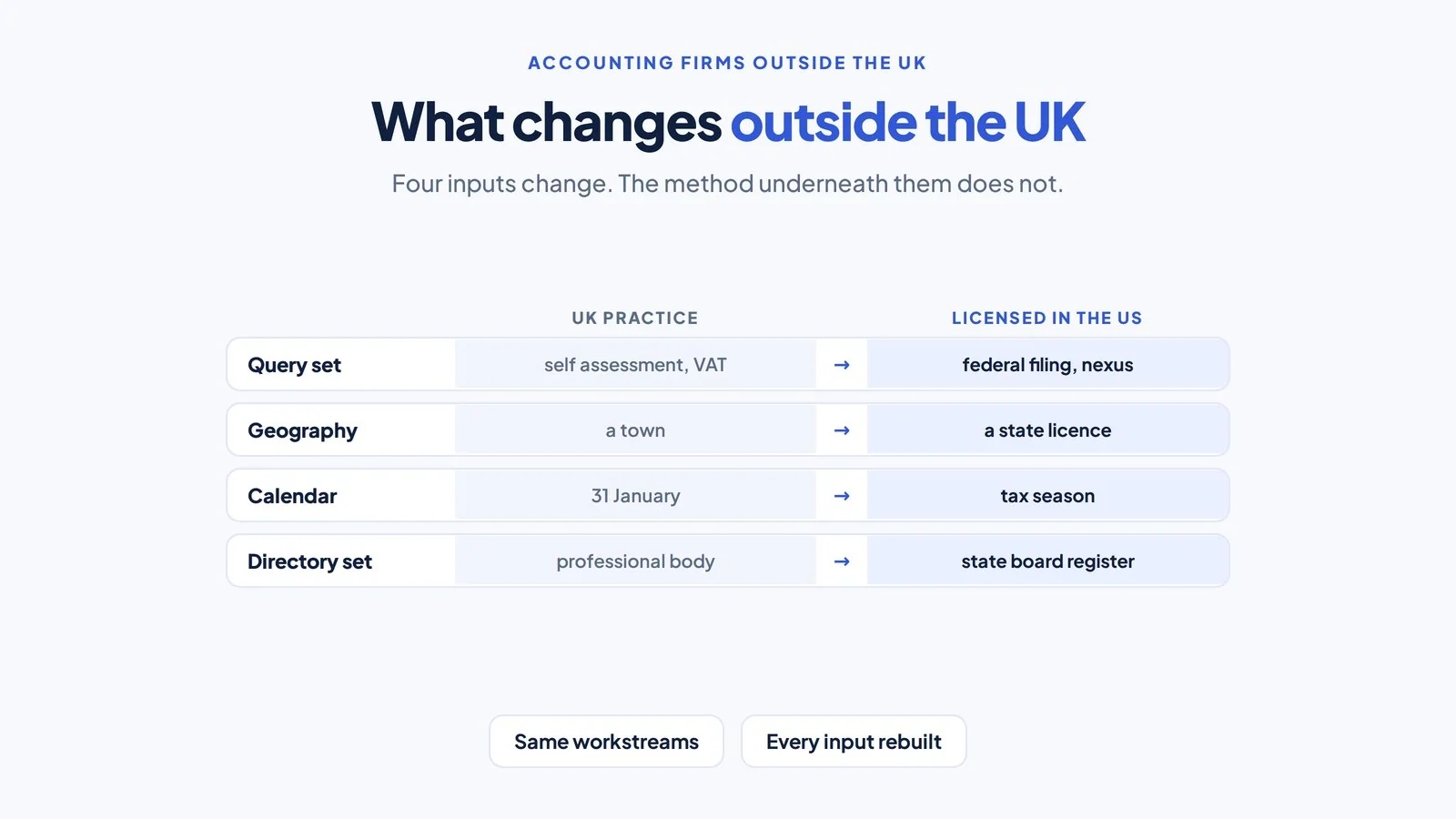
Four things change when an accounting firm outside the UK builds search visibility, and the method is not one of them. The query set changes, because clients search for a licence rather than a qualification. The geography changes, because a CPA licence is issued by a state and practice privilege decides how far it travels. The calendar changes, because tax season compresses a year of demand into the weeks between the opening of filing and the deadline. The directory set changes, because the listings that carry weight in the United States are not the ones that carry weight in Britain.
Everything else holds. You still win by covering a topic more completely than the firms above you, and by being the only source that answers the question a client actually typed at eleven at night.
Key Takeaways
- The method does not change across markets. Your query set, your geography, your busy season and your directory set do.
- NASBA states that a CPA “is a certified public accountant who is licensed by a state board of accountancy”, which makes the state a genuine entity in the query rather than a location tag.
- Practice privilege lets a CPA in good standing serve clients in other states without a second licence where certain requirements are met, so a multi state firm rarely needs a page for every state.
- Tax season is a publishing constraint rather than a marketing season, because the content that wins in March has to be indexed by January, which puts the writing in your quiet months.
- Your best pages answer a client situation, not a service name. That holds on both sides of the Atlantic.
- AEO and SEO are the same work for a firm this size, and a provider pricing them separately is charging twice for the same hours.
- Our published research covers 494 UK practice websites. No equivalent United States sample exists in it, and nothing here is presented as a measured US finding.
Accountancy and accounting firms
Running a firm outside the UK?
We rebuild the research against your own market before writing anything, then show you the query set your firm should own.
Measured, not estimated
Demand read from our own Search Console, and the research we published on the practice web estate.
- 4,929CPA query impressions, no page built
- 39.6weighted position across those queries
- 494practice websites in our study
What does SEO for a CPA firm involve, and how is it different from SEO for a UK practice?
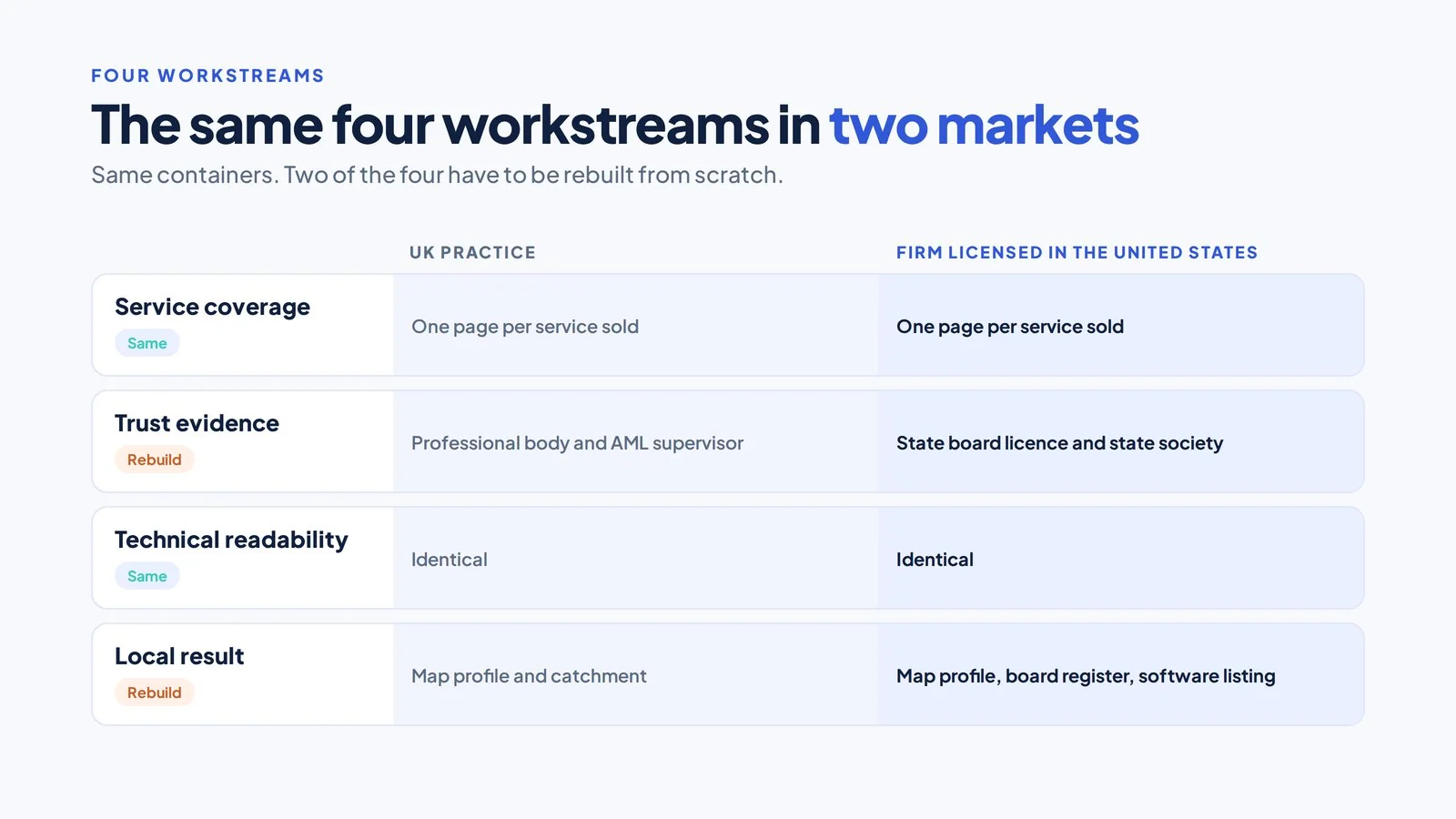
SEO for your firm involves the same four workstreams as any accounting practice. A page for every service worth buying, evidence that your firm is real and licensed, a site a search engine can read cheaply, and a profile that wins the local result. The difference sits in what fills those workstreams, not in the workstreams themselves.
One point on the title itself before the detail, because it decides who this page is for. CPA is not a United States only designation. It is used by CPA Canada and CPA Australia among others, so a firm holding it may be licensed anywhere, and the page set changes with the licensing jurisdiction rather than with the three letters. The worked example below is a firm licensed in the United States, because that is where the search volume concentrates, and the structure transfers.
A UK practice writes about self assessment, Companies House filing deadlines, VAT registration thresholds and Making Tax Digital. Your firm writes about federal and state filing, quarterly estimated payments, entity election, sales tax nexus and the state credits your clients qualify for. Neither list is transferable, and a page naming the wrong statute reads to your client exactly as it reads to you: written by somebody who has never sat through the work.
The trust layer differs in the same way. A UK practice names its professional body and its anti money laundering supervisor. Your firm names the board that licensed it. That is not a cosmetic swap, because it changes which entity a search engine can connect you to.
Set the two side by side and the pattern is clear: the columns hold, the contents do not.
| Input | UK practice | Firm licensed in the United States |
|---|---|---|
| Credential named on the site | ICAEW, ACCA, ICAS, AAT membership | State board licence, and the state society |
| Deadline content is built around | 31 January self assessment, Companies House filing dates | Federal filing deadline, quarterly estimates, extension season |
| Recurring compliance topic | VAT and Making Tax Digital | Sales tax nexus and multi state filing |
| Structural advice clients search for | Sole trader or limited company | Entity election and reasonable compensation |
| Oversight body clients recognise | HMRC, Companies House | IRS, state departments of revenue |
| Regulator named for supervision | Anti money laundering supervisor | Board of accountancy |
| Directory that carries real weight | Professional body register, map profile | State board register, state society, software partner directory |
Our broader approach to a practice is set out in SEO for accountants, including how we handle the international codes of conduct that sit behind advertising standards in different jurisdictions.
Which queries does a CPA firm actually get found for?
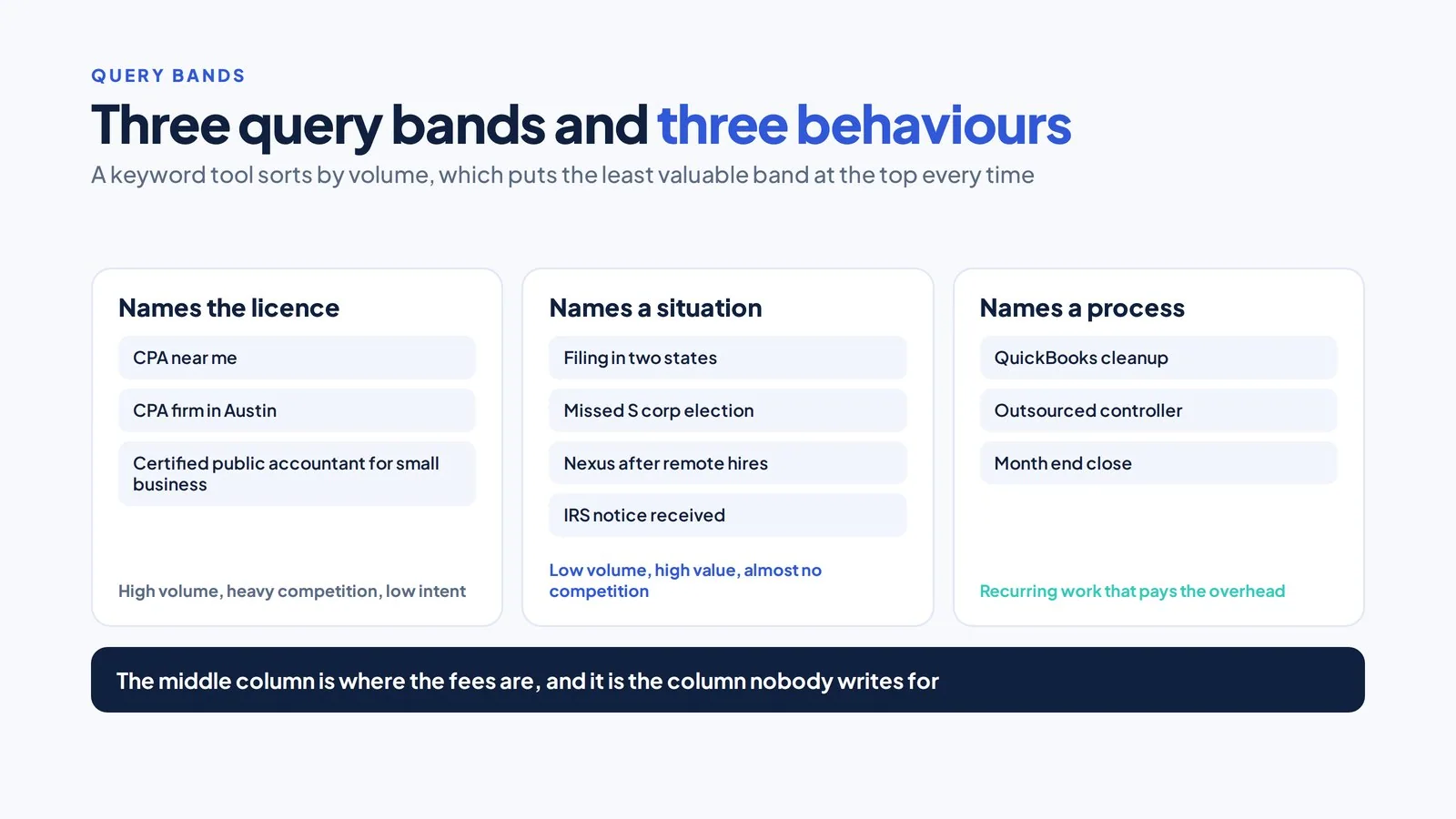
Your firm gets found for three bands of query, and they behave differently enough that treating them as one list wastes most of your budget.
The first band names the licence. “CPA near me”, “CPA firm in Austin”, “certified public accountant for small business”. These are the searches your staff assume the website is for. These carry volume, carry every firm in your metro area, and convert at the level you would expect from a search that names no problem.
The second band names a situation. “Do I need to file in two states”, “S corp election deadline missed”, “sales tax nexus after remote employees”, “IRS notice CP2000 what to do”. These carry a fraction of the volume and most of your fee income, because the person typing them has a problem they cannot solve and a deadline attached to it. They are the calls you want at nine on a Monday.
The third band names a software or a process. “QuickBooks cleanup”, “outsourced controller”, “month end close”. These bring the recurring work that pays your overhead and fills the months either side of the season.
Firms build for the first band by default, because it is the band a keyword tool puts at the top. The firms that pull ahead build for the second, because almost nobody else does. Look at your own site and count how many pages sit in each band. Where those pages can live is the next constraint, because in your market the place name on a page carries a credential as well as a location.
How does state licensure change the page set?
State licensure turns geography into a credential, which means a location page for a CPA firm carries something a UK location page never does. NASBA states the position plainly: a CPA “is a certified public accountant who is licensed by a state board of accountancy”. A client searching in a state is not only asking who is nearby. They are asking who is licensed to sign their return.
That changes what your state or city pages have to contain. Each needs the licence, the board, the services you offer to clients there and the filing obligations specific to that state. A page carrying none of those is a template with a place name swapped in, which is the exact pattern set out in why accountancy location pages fail.
The practical rule follows from the content, not from the map. Build a page for a state where you can say something true and specific that you cannot say about anywhere else. Skip the rest.
Does a multi state firm need a page for every state?
You almost never need a page for every state you serve, because practice privilege already covers most of the work. NASBA describes it directly: practice privilege, or CPA mobility, “laws allow CPAs in good standing to serve clients in other states without obtaining a second license, providing certain requirements are met”. NASBA also notes that a majority of states have adopted mobility legislation, without publishing a count, so the count is not something to assert.
Amy Tongate, NASBA’s Director of Compliance Services, describes the direction of travel as a shift from where a CPA is licensed to how a CPA was licensed, moving from something state based to something individual based.
Build state pages where three conditions hold together: real clients in that state, a filing obligation or credit worth explaining, and a search volume that justifies the page existing. Fifty pages built on a template will not outrank five pages built on engagements you actually ran, and a search engine reads the difference faster than most partners expect. Having fewer pages to build makes the next question the harder one, which is when to build them.
Topical authority
The method that travels between markets
Topic coverage does not have a nationality. The entities, deadlines and competitor set do, and those are what the research stage rebuilds.
What does tax season do to a publishing plan?
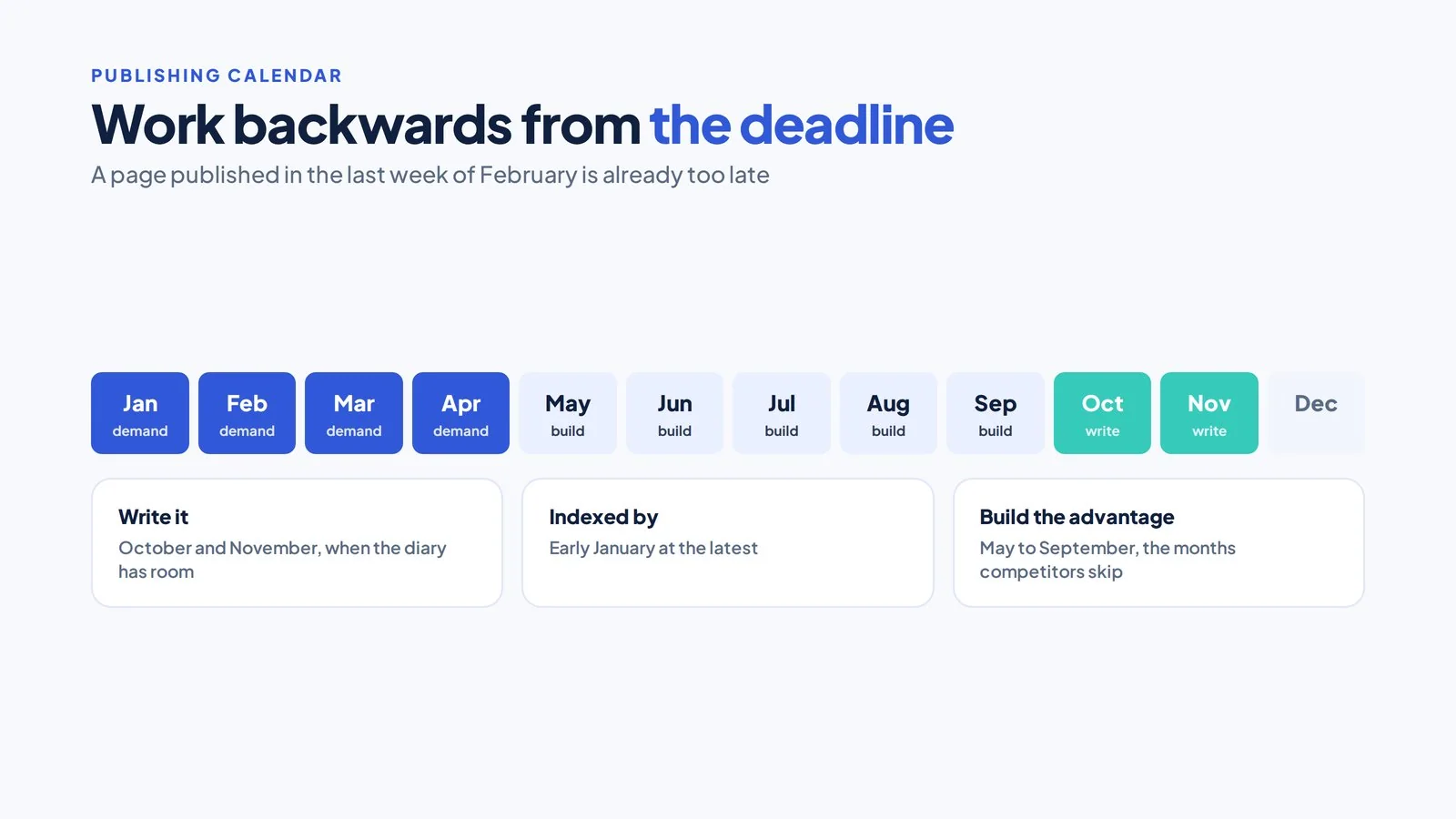
Tax season compresses most of your year’s search demand into the weeks between the opening of filing and the deadline, which turns publishing into a scheduling problem rather than a volume problem. A page you publish in the last week of February competes against pages that have been indexed, linked and refined since the previous autumn.
Work backwards from that. Content aimed at the filing deadline belongs in the index by early January at the latest, which puts your writing in October and November, when the diary has room for it. Content aimed at extension season belongs in the index by early summer. Content aimed at quarterly estimates belongs in the index before the first quarterly date, then updated rather than rewritten each year.
Your quiet months are where the advantage gets built. A firm writing nothing between May and September spends February competing against firms that used those five months to build the pages now beating it. The same quiet months are when the listings below get cleaned up, and they take an afternoon rather than a quarter.
Which directories and citations carry weight for a firm outside the UK?
The listings that matter to your firm divide into four groups, and only one of them is a directory in the usual sense.
The first is the state board’s own register. Your licence record is a public entity reference, and it is the strongest trust signal you have, because nobody can fake it.
The second is the professional body. Your membership of the national institute, and of a state society where one exists, carries the same function the professional body listing carries for a UK practice.
The third is the software partner directory. Accounting platforms list certified firms, and those listings send you referrals as well as a verifiable statement that you work in the software your client already runs.
The fourth is the general local set: the map profile, the national business directories, the chamber of commerce. Useful, and the least distinguishing of the four, because every competitor on your street has them too.
Consistency across all four matters more than the count. A firm name, address and phone number that disagree between two listings weakens both, and the fix is an afternoon at the front desk that firms routinely postpone. The wider mechanics of winning a local result, including how a profile and a website support each other, are covered in local SEO for accountants.
How does firm structure change the pages you build?
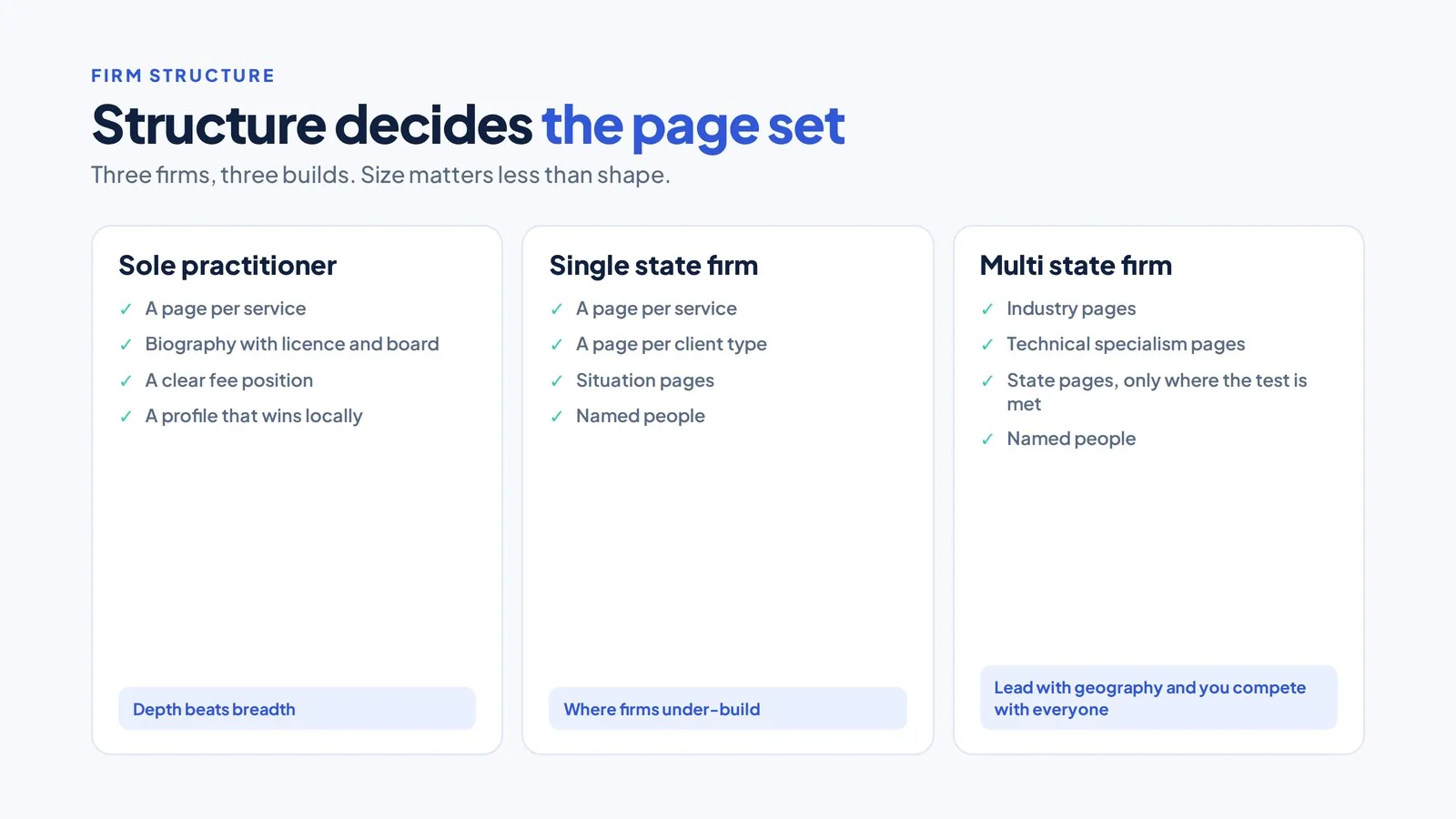
Your firm’s structure decides the page set more directly than its size does, and three structures need three different builds. Find yours below.
A sole practitioner competes on being findable and being trusted by one person, which is you. The build is a small site: a page per service, a real biography carrying your licence and your board, a clear fee position and a profile that wins the local search. Depth beats breadth, because you cannot service breadth from one desk anyway, and a client can tell when you are pretending to.
A single state firm with a team competes on service coverage. Your build adds a page for every service worth buying, a page per client type you serve, and the situation pages that bring the higher value work. This is where firms under-build most often, usually because the service list on the site describes what you sell rather than what your clients type.
A multi state firm competes on specialism. Your build leads with the industries and the technical work you are known for, then supports it with state pages only where the earlier test is met. Lead with geography at this size and you end up competing with every local firm in every market you enter, on their ground rather than yours. Whichever of the three you are, two pages decide more of the outcome than the rest of the site put together, and both of them are about what you are willing to publish.
What should you publish that your competitors probably have not?
Fee information is the first thing worth checking against your own competitors, because publishing nothing is a position rather than a default. Our own audit of 494 UK practice websites found 87.2% publishing no price figure at all. That is a UK measurement and we have no United States equivalent, so rather than guess at your market, open the sites of the three firms nearest you and count how many publish a figure. That count is your answer, and it takes ten minutes.
Publishing a number is not your only option. You can publish a range, a starting fee, a worked example of what a typical engagement costs, or the four things that move a quote up and down. All four give a searcher something to act on, and all four outperform “contact us for pricing”.
The second thing to check is the client outcome. Count how many of those same three competitors publish a named engagement, a sector case study or a specific result, and how many publish an anonymous testimonial instead. Where your own professional rules permit it, the case study is the highest value page you will build, because it is the only page a competitor cannot copy off you. Reviews do the same job for the clients who will never agree to appear in one.
How do reviews work for a firm bound by client confidentiality?
Reviews work the same way for an accounting firm anywhere: ask everyone, ask at the right moment, and never write or shape the content. The confidentiality constraint is about what you say in reply, not about whether you may collect reviews at all.
Reply without confirming anything. A public reply naming a client’s situation, their entity type or their filing problem confirms an engagement your client may not have intended to make public, and it does that permanently. Thank the reviewer, state your standard of service, and take the detail to a private channel.
The moment matters more than the wording of your request. Ask at completion, when the client has just received something they were worried about and is still relieved. Ask in the third week of the season, when nobody has received anything yet, and you will get the response rate you would expect.
BrightLocal’s Local Consumer Review Survey 2026, a sample of 1,002 United States consumers, found 97% reading reviews for local businesses, 41% always reading them against 29% a year earlier, and 45% using ChatGPT and similar tools for local recommendations against 6% a year earlier. That last figure is the one worth sitting with, because it describes a buying behaviour that did not meaningfully exist two years ago, and it is the reason AI and LLM visibility now sits inside the same programme rather than beside it.
AEO or SEO: which should a CPA firm be buying in 2026?
Both, from the same work, and a provider selling them as two products is selling you the same hours twice. Answer engine optimisation describes getting your firm quoted inside an answer. Search engine optimisation describes getting your pages retrieved in the first place. An assistant cannot quote a page that was never retrieved, so the second is the input to the first rather than its replacement.
What changes for a firm your size is the shape of the question being asked. A business owner typing into a search box writes “cpa near me” or “s corp tax preparer dallas”. The same owner asking an assistant writes a situation: a CPA for a two state construction company that just picked up work in Texas, or someone who can fix three years of unfiled returns. Those sentences name an entity, a jurisdiction and a problem all at once, and the page that gets quoted is the one that already contains all three in a sentence of its own.
Three properties decide whether your pages are quotable, and all three are ordinary page work.
- The answer sits in the first sentence under the heading, before any context. A section that builds to its answer in the fourth paragraph is skipped by an assistant and read by nobody else either.
- The jurisdiction is named in the text rather than implied by the address in the footer. A page about sales tax nexus that never names a state is a page about nothing specific.
- The licence is stated in a form a machine can connect to a register. The state board that licensed the firm, named in words on the page, does work that a logo in a footer does not.
Demand here is real and it is recent. BrightLocal’s 2026 survey of 1,002 United States consumers found 45% using ChatGPT and similar tools for local recommendations, against 6% a year earlier. That figure is a consumer sample rather than a business buyer sample, so read it as direction rather than as a forecast for your own enquiry mix.
Treat any guaranteed mention in an AI answer as a reason to end the conversation. Nobody controls which source an assistant picks. What a firm controls is whether a quotable, jurisdiction specific, licence backed answer exists on a page at all, and most firms in this market still have none.
What does not change between the two markets?
The method does not change, and that is the part firms are usually most sceptical about.
Search engines rank a source on how completely it covers a topic and how cheaply it can be understood, and neither of those has a nationality. Publish one page per real service, answer the question in the first sentence of every section, link your pages so that supporting content feeds the pages that sell, and keep a site a crawler can read without effort, and you will outperform a firm that does none of it. That holds in Cardiff and it holds in Charlotte.
What changes is every input. The entities, the statutes, the deadlines, the bodies, the directories, your competitor set and the words your clients use. Getting those wrong is what makes a transplanted UK page read as foreign to the person reading it, and it is why the research stage for your market takes longer than the writing.
Our method is set out in full in semantic SEO and topical authority, and the reason it travels is that it is built on topic coverage rather than on any one market’s keyword list.
What does a consultancy in the UK have to do differently to run this?
A UK consultancy running work for a firm in another country has to solve four practical problems, and you are entitled to ask how each is handled before you sign anything.
Hours come first. A five to eight hour offset means a call lands in one party’s early morning or the other’s evening, and pretending otherwise produces a relationship where nobody speaks. Fix the slot at the start, put it in the engagement letter, and block it in both diaries.
Research access comes second. Search data, competitor sets and local results all vary by location, so the work has to be done against your market rather than against a default. A consultancy that cannot show you results sampled from your own state is showing you somebody else’s market.
The third is subject matter. Nobody in Cardiff should be writing about a state credit unaided. The workable model is a review step where your own people check every factual claim before it publishes, the same partner sign off we use with UK practices on regulated content. Name who signs off before the first page is written.
The fourth is contract and currency. Terms, invoicing currency and payment method are administrative rather than interesting, and they are also the reason a promising conversation stalls in week three. Settle them in the first call.
What does this cost, and what is a normal fee outside the UK?
Fees outside the UK sit higher than most British practices expect, and the published survey data is the only neutral reference either side can point at. Ahrefs surveyed 439 SEO service providers, published the results in December 2023 and updated them in August 2024. The average monthly retainer came out at 2,917 US dollars, the most common retainer band at 501 to 1,000 US dollars a month, the average hourly rate at 111 US dollars, and the most common project fee band at 2,501 to 5,000 US dollars.
Read those two retainer figures together rather than separately. A common band of 501 to 1,000 dollars against an average of 2,917 tells you the market has a long tail of expensive engagements pulling the mean up, which is what you would expect where a minority of providers run full programmes and the majority sell tasks. Work out which one you are being quoted for.
Our own published prices are in sterling and are the same whoever asks: local work from 399 pounds a month, full service from 699 pounds a month with no notice period and no setup fee, and a niche programme from 1,495 pounds a month, all excluding VAT. Currency, invoicing and the terms in your engagement letter are settled before work starts rather than assumed. The way a fee is structured, and what each band actually buys month by month, is worked through in what SEO costs an accountancy practice.
Judge a quote on what lands in your inbox each month rather than on the number at the bottom. A retainer producing two blog posts and a ranking report is a task list at any price, and you will feel that by the third invoice.
How do you judge whether the work is landing?
Judge it on four measures, in this order, and ignore the rest for your first six months.
Impressions against the situation queries come first, because they move before rankings do and they tell you whether your pages are being shown for the searches that carry money. Rankings for the licence band come second, because they move slowly and confirm the direction. Enquiries with a named source come third, and they only exist if whoever answers your phone asks every caller how they found you. Engagement value comes fourth, because ten enquiries for cleanup work and one for a multi state advisory engagement are not the same result, and a count on your board pack treats them as though they were.
Six months is the earliest point any of this is readable. Anybody promising you movement in six weeks is promising something they do not control.
Self-check quiz
Is your firm built for search or for a brochure?
Eight questions about the site you have today. Open it in another tab before you start.
Question 1 of 8Your site names the board that licensed the firm:
Question 2 of 8Every service you sell has its own page:
Question 3 of 8Pages answering a client situation rather than naming a service:
Question 4 of 8Your fee position on the site is:
Question 5 of 8State or city pages you have built:
Question 6 of 8Content written for the filing deadline was published:
Question 7 of 8Your firm name, address and phone number across your listings:
Question 8 of 8Client outcomes published on the site:
Show the answer key
- Your site names the board that licensed the firm: On the home page and the about page. The licensing board is the strongest verifiable trust signal a firm has.
- Every service you sell has its own page: Yes, one page each. A grouped services page cannot rank for any single service search.
- Pages answering a client situation rather than naming a service: Several, updated. Situation queries carry a fraction of the volume and most of the money.
- Your fee position on the site is: A figure, a range or a worked example. Publishing something always beats publishing nothing.
- State or city pages you have built: Only where you have real clients and something specific to say. A template page with a place name swapped in is the pattern search engines discount hardest.
- Content written for the filing deadline was published: The previous autumn. A page published in February competes with pages indexed the previous October.
- Your firm name, address and phone number across your listings: Match exactly everywhere. Listings that disagree weaken each other.
- Client outcomes published on the site: Named engagements or sector case studies. The case study is the only page a competitor cannot copy.
Frequently asked questions
Does SEO work differently for a CPA firm than for a UK accountancy practice?
The method works the same way and every input differs. The workstreams, the page structure and the way topic coverage is built are identical. The statutes, deadlines, licensing bodies, directories, competitor set and client vocabulary all have to be rebuilt from the firm’s own market.
Do I need a separate page for every state I serve?
Almost never. Practice privilege lets a CPA in good standing serve clients in other states without a second licence where certain requirements are met, so geography is rarely your constraint. Check your own position before building on it. Build a state page where you have real clients there, a filing obligation or credit worth explaining, and enough search demand to justify the page.
How long does it take before a firm sees a change?
Impressions usually move first, and they are readable in weeks to a few months once your pages are indexed. Rankings for competitive licence queries take longer, commonly six to nine months. Anyone offering you a date for a specific position is offering a date for something they do not control.
Should a firm publish its fees?
Publishing something beats publishing nothing. A range, a starting figure, a worked example or the factors that move your quote all give a searcher a reason to act, and all of them outperform an invitation to get in touch for pricing.
Can a consultancy outside the United States write technical tax content?
Not unaided, and it should not try. The workable arrangement is that the consultancy builds the structure, the query research and the page plan, and your own licensed people review every technical statement before it publishes. Content that skips that step is the fastest way to lose the trust the site is meant to build.
Our firm holds a CPA designation outside the United States. Does that change the page set?
It changes the register you name and the deadlines you write about, and nothing else. The structure in the table above holds for a firm in Canada or Australia with the credential swapped and the filing calendar replaced, because the reader’s question is the same in every market: is this firm licensed, does it do my kind of work, and can it act where I am. Name the body that actually licensed you, in words, on the page.
Where a firm outside the UK fits in the rest of this work
Treat the market difference as an input to the research rather than as a different service. Your firm needs its own entity set, its own deadlines and its own competitor analysis, and it needs the same underlying build as any practice: one page per service worth buying, evidence a stranger can verify, and a site that costs a search engine nothing to read.
True SEO Consultants Ltd works from Startup Stiwdio at the University of South Wales, 86-88 Adam Street, Cardiff, CF24 2FN, and delivers through remote digital onboarding and delivery. Mohammad A Mahmud completed the ACCA professional examinations and holds an MSc in Applied Accounting from the University of South Wales, and Julie Williams is a fractional finance director and certified business coach, so the conversation about an accounting firm’s economics happens in the firm’s own language. We bill on KPIs, not hours, and we publish our own research rather than borrowing statistics. Research Report TSC-2026-01, our audit of 494 accountancy practice websites, is a UK sample and we label it as one every time it appears.
Bring your market and we will read it with you
We look at your state, your competitor set and the situation queries nobody in your market is answering, then tell you what we would build first.
Book my free strategy callSee our consultancy service